
¿Cuánto cuesta un CRM para fabricantes en 2026? Una guía de TCO de 3 años.
Cómo construir un presupuesto de CRM de tres años defendible que pueda ser aprobado por el CFO, el responsable de operaciones y el equipo de TI.

Christian Wettre
EVP, GM North America
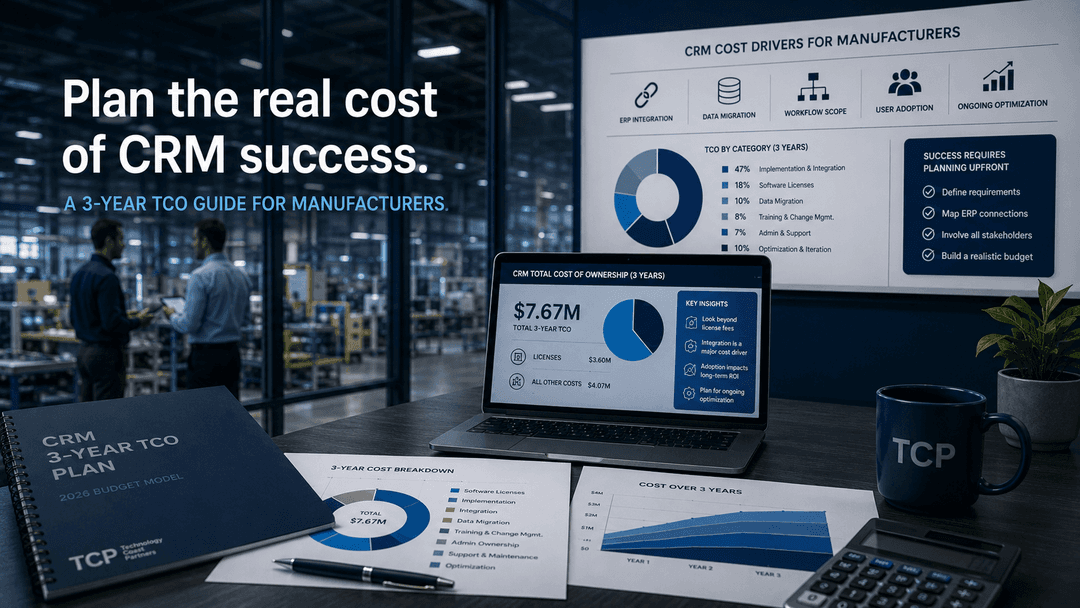
El número que cita tu proveedor de CRM y el que aprueba tu CFO 18 meses después del despliegue rara vez son los mismos.
La mayoría de los fabricantes entran a una evaluación de CRM comparando precios por usuario. Parece el punto de partida correcto. No lo es.
Para una organización manufacturera, la tarifa de licencia suele ser la parte más pequeña de lo que realmente cuesta un CRM en tres años. El presupuesto real se construye a partir de la complejidad de la integración, la migración de datos, el alcance de los flujos de trabajo, la propiedad administrativa y la adopción, y esos costos varían de manera drástica dependiendo de tu entorno ERP, tu huella operativa y cuánto trabajo de proceso se pospuso antes de que comenzara el proyecto.
Forrester's Total Economic Impact study on Salesforce for Manufacturing puts the 3-year risk-adjusted cost at $7.67M for a composite manufacturing organization - with only $3.6M of that in subscriptions. The remaining $4.1M covers implementation, integration, change management, and ongoing administration. That split is not an outlier. It reflects how manufacturing CRM projects actually land.
Qué cubre esta guía:
- Cómo construir un modelo defensible de TCO de CRM a 3 años en el que tu CFO, líder de operaciones y líder de IT puedan respaldarlo
- Cómo se ven en realidad los benchmarks de precios de 2026 para SugarAI, Salesforce, HubSpot y Microsoft Dynamics 365
- Dónde los presupuestos de manufactura se expanden rápido, y cómo verlo venir antes de firmar un contrato
Qué deben incluir los fabricantes en el costo total de propiedad de un CRM
Un modelo TCO útil tiene que contemplar cada cubo de costos, no solo los que aparecen en la página de precios del proveedor. A continuación, la lista completa de lo que pertenece al presupuesto de un CRM para manufactura.
Los ocho rubros de costos
- Licencias de software - tarifas base por usuario, niveles de edición y mínimos a nivel de plataforma
- Implementación - gestión de proyectos, configuración, pruebas y soporte de puesta en producción
- ERP y la integración de sistemas - conectar el CRM con Epicor, su ERP u otros sistemas operativos
- Migración de datos - extracción, desduplicación, mapeo de campos, limpieza y validación
- Capacitación y gestión del cambio - formación de usuarios finales, habilitación de gestores y soporte de adopción
- Propiedad administrativa - administración continua del sistema, ya sea interna o externalizada
- Soporte y mantenimiento - niveles de soporte del proveedor, acuerdos de soporte con socios y cobertura de corrección de fallos
- Optimización e iteración - mejoras post-implementación, creación de informes y expansiones de flujo de trabajo
Los mayores errores de presupuesto que vemos provienen de tratar los ítems 3 a 8 como ideas de posproducción. No lo son. En entornos de manufactura, a menudo es donde reside la mayor parte del costo a 3 años.
Por qué la manufactura es diferente del CRM genérico B2B: Tu CRM tiene que funcionar junto a tu ERP. Las cotizaciones de ventas deben reflejar las listas de materiales y los precios actuales. Los casos de servicio deben conectarse a los datos de producción e inventario. Los registros de clientes deben permanecer sincronizados entre ambos sistemas. Esa dependencia de datos operativos añade alcance de integración que una implementación típica de un CRM SaaS no requiere.
Forrester TEI for Salesforce Manufacturing encontró que la implementación y la integración por sí solas representaron $2.0M del costo a 3 años en su modelo compuesto, antes de añadir $2.1M en gestión del cambio y administración. Eso es $4.1M en costos no ligados a licencias para una gran empresa. La razón se mantiene a menor escala también.
Los fabricantes que usan Epicor Kinetic enfrentan decisiones de integración específicas: sincronización bidireccional frente a extracción de datos de solo lectura, real-time vs. actualizaciones por lotes, y cómo manejar las transferencias de cotización a pedido entre CRM y ERP sin crear registros duplicados ni flujos de trabajo rotos. Estas no son preguntas de configuración. Son decisiones de arquitectura que afectan el costo y el cronograma.
Migración de datos
El costo de migración rara vez se trata de volumen. Se trata de calidad. Un fabricante con 50,000 registros de clientes limpios y estructurados migra más rápido y barato que uno con 15,000 registros repartidos en tres sistemas legados, dos hojas de cálculo y una laptop de un representante de ventas que se retira.
La deduplicación, el mapeo de campos, las decisiones sobre datos históricos y el rediseño de procesos durante la migración son donde los plazos fluyen y los presupuestos crecen. Las discusiones de la comunidad sobre ERP-CRM unification señalan consistentemente la calidad de los datos como el riesgo de ejecución principal, no la tecnología.
Propiedad administrativa
| Platform | Typical Admin Model | Annual Cost Signal |
|---|---|---|
| Salesforce | Dedicated Salesforce Admin (often full-time) | $80K-$120K+ salary or outsourced equivalent |
| HubSpot | Part-time admin or RevOps resource | Lower, but scales with customization |
| Dynamics 365 | IT-adjacent admin, Microsoft ecosystem familiarity required | Varies; higher with custom integrations |
| SugarAI | Lighter admin footprint; platform-native configuration reduces custom code dependency | Lower ongoing overhead in standard manufacturing deployments |
Alcance del alcance
Empieza con "¿podemos añadir cotización?" Luego servicio de campo. Luego tableros ejecutivos. Luego un portal para clientes. Cada adición es razonable por sí sola. Juntas, pueden duplicar el alcance de la implementación respecto a lo originalmente previsto. Define tus límites de flujo de trabajo antes de firmar y conviértelo en un proceso de cambio de orden dentro del contrato desde el primer día.
Un modelo de presupuesto para manufactura: escenarios de despliegue bajo, medio y complejo
Los rangos a continuación son puntos de referencia direccionales basados en estudios publicados de TCO, datos de implementación y discusiones de compradores en el mundo real. Los costos reales dependen de tu arquitectura, la calidad de los datos y las decisiones de alcance, no de las categorías de marketing de los proveedores.
Estos escenarios asumen un despliegue de 50 usuarios durante 3 años.
Rangos de TCO a 3 años por complejidad de despliegue
| Scenario | Description | Estimated 3-Year TCO Range |
|---|---|---|
| Low complexity | Single site, limited ERP integration, clean data, standard workflows, light admin needs | $150K - $300K |
| Mid complexity | ERP sync required, structured migration, quoting or service workflows, formal reporting | $350K - $700K |
| High complexity | Multi-site, bidirectional ERP integration, custom quoting, field service, heavy governance | $800K - $1.5M+ |
Ranges include licenses, implementation, integration, migration, training, and 3-year admin/support. They do not include internal labor costs for project team time.
Qué mueve entre categorías
Unas cuantas decisiones tienen un impacto desproporcionado en dónde queda tu proyecto:
- Profundidad de la integración - extracción de datos ERP de solo lectura vs. sincronización bidireccional con datos de pedidos e inventario en tiempo real
- Preparación de datos - registros limpios y estructurados vs. limpieza multi-fuente y desduplicación requerida
- Alcance del flujo de trabajo - solo pipeline de ventas vs. cotización, servicio, portal del cliente e informes ejecutivos
- Modelo de administración - administración nativa de la plataforma vs. código personalizado que requiere la participación de un desarrollador
Dónde SugarAI tiende a encajar en la manufactura
Para fabricantes de tamaño medio en el rango de ingresos de 25 M$ a 250 M$ que ejecutan Epicor o un ERP comparable, la arquitectura de SugarAI tiende a reducir la fricción en dos áreas específicas: la configuración de la integración y la sobrecarga administrativa continua. La plataforma está diseñada con conectividad CRM-ERP como una suposición de diseño central en lugar de un complemento, y su modelo de configuración reduce la dependencia de desarrollo personalizado que impulsa el costo administrativo en plataformas horizontales más amplias.
Eso no la hace adecuada para todas las organizaciones. Un fabricante que ya opera un stack completo de Microsoft puede encontrar que Dynamics 365 ofrece mejores economías totales gracias a licencias existentes. Una gran empresa con requisitos complejos de CPQ puede necesitar la profundidad de Salesforce. Pero para fabricantes de tamaño medio que priorizan una implementación conectada y de menor sobrecarga, el panorama de costos a 3 años de SugarAI merece modelarse junto a los otros antes de tomar una decisión.
Conclusión práctica: la plataforma con el precio por asiento más bajo no siempre es la que tiene el costo a 3 años más bajo. Modela los tres escenarios de complejidad antes de finalizar la preselección de proveedores.
Cómo comparar proveedores sin caer en la trampa de precios publicitados bajos
El CRM que parece más barato en el ciclo de demostraciones puede convertirse en la plataforma más cara en el segundo año. Aquí tienes un marco práctico de puntuación para comités de compra de manufactura.
Criterios de evaluación ponderados para fabricantes
[SANITY_BLOCK:eyJfa2V5IjoiZDc0MWY1YjEwZjlmIiwiX3R5cGUiOiJtYXJrZG93bkJsb2NrIiwiYm9keSI6InwgQ3JpdGVyaW9uIHwgV2h5IGl0IG1hdHRlcnMgdCBRdWVzdGlvbnMgdG8gYXNrIHZlbmRvcnMgfFxufCAtLS0gfCAtLS0gfCAtLS0gfFxufCAqKkVSUCBpbnRlZ3JhdGlvbiBmaXQqKiB8IERldGVybWluZXMgaG93IG11Y2ggY3VzdG9tIHdvcmsgaXMgcmVxdWlyZWQgdG8gY29ubmVjdCBDUk0gdG8gb3BlcmF0aW9uYWwgZGF0YSB8IERvZXMgdGhlIHBsYXRmb3JtIGhhdmUgYSBuYXRpdmUgb3IgY2VydGlmaWVkIGNvbm5lY3RvciBmb3IggeW91ciBFUlA/IFdoYXQgaXMgdGhlIHN5bmMgYXJjaGl0ZWN0dXJlPyB8XG58ICoqQWRtaW4gb3ZlcmhlYWQqKiB8IERyaXZlcyBvbmdvaW5nIG9wZXJhdGluZyBjb3N0IGJleW9uZCBsaWNlbnNlcyB8IEhvdyBtYW55IGRlZGljYXRlZCBhZG1pbiBob3VycyBwZXIgd2VlayBkb2VzIHRoZSBwbGF0Zm9ybSByZXF1aXJlIGF0IHlvdXIgc2NhbGU/IHxcbnwgKipXb3JrZmxvdyBzY29wZSBjb3ZlcmFnZSoqIHwgRGV0ZXJtaW5lcyB3aGV0aGVyIGFkZC1vbnMgYXJlIG5lZWRlZCBmb3IgcXVvdGluZywgc2VydmljZSwgb3IgcmVwb3J0aW5nIHwgV2hhdCBpcyBpbmNsdWRlZCBpbiB0aGUgYmFzZSBsaWNlbnNlIHZzLiB3aGF0IHJlcXVpcmVzIGFkZGl0aW9uYWwgbW9kdWxlcz8gfFxufCAqKk1pZ3JhdGlvbiBzdXBwb3J0KiogfCBBZmZlY3RzIGJvdGggdGltZWxpbmUgYW5kIGJ1ZGdldCByaXNrIHwgV2hhdCBkb2VzIHRoZSBpbXBsZW1lbnRhdGlvbiBwYXJ0bmVyIG1pZ3JhdGlvbiBtb2R1bGxvZ2xvb2sgbGlrZSBmb3IgbWFudWZhY3R1cmVycz8gfFxufCAqKlRvdGFsIDMteWVhciBjb3N0IG1vZGVsaW5nKiogfCBUaGUgb25seSBudW1iZXIgdGhhdCBtYXR0ZXJzIGZvciBhIGRlZmVuc2libGUgYnVkZ2V0IHwgQ2FuIHRoZSB2ZW5kb3Igb3IgcGFydG5lciBwcm92aWRlIGEgc2NlbmFyaW8tYmFzZWQgMy15ZWFyIFRDTyBlc3RpbWF0ZT8gfCJ9]
Un CRM orientado a manufactura debería [score well] en ajuste de integración y sobrecarga administrativa antes de destacar por reconocimiento de marca o pulido de la interfaz. Esos dos criterios son donde realmente reside el riesgo presupuestario.
Los datos de Nucleus Research respaldan este marco: el ROI de CRM se impulsa por la adopción y la eficiencia de procesos, no por la cantidad de funciones. Una plataforma que tu equipo realmente pueda usar, conectada a los datos operativos que necesitan, superará consistentemente a una plataforma más potente que requiere un administrador a tiempo completo para mantenerla en funcionamiento.
Qué debe validar cada uno de los responsables: CFO, líder de operaciones y líder de IT antes de la aprobación
Una inversión en CRM a esta escala requiere la aprobación desde tres perspectivas distintas. Aquí está lo que cada interesado debe confirmar antes de que el proyecto avance.
[SANITY_BLOCK:eyJfa2V5IjoiY2RkOTk4YzA3NTJlIiwiX3R5cGUiOiJtYXJrZG93bkJsb2NrIiwiYm9keSI6InwgU3Rha2Vob2xkZXIgfCBNdXN0IHZhbGlkYXRlIGJlZm9yZSBhcHByb3ZhbCB8XG58IC0tLSB8IC0tLSB8XG58ICoqQ0ZPKiogfCBGdWxsIDMteWVhciBjb3N0IG1vZGVsIHdpdGggbGljZW5zZSwgaW1wbGVtZW50YXRpb24sIGludGVncmF0aW9uLCBtaWdyYXRpb24sIGFkbWluLCBhbmQgc3VwcG9ydCBsaW5lIGl0ZW1zLiBTZW5zaXRpdml0eSByYW5nZXMgZm9yIGxvdy9taWQvY29tcGxleCBzY2VuYXJpb3MuIFJPSSBhc3N1bXB0aW9ucyB0aWVkIHRvIHNwZWNpZmljIGVmZmljaWVuY3kgZ2FpbnMsIG5vdCBnZW5lcmljIHZlbmRvciBiZW5jaG1hcmtzLiB8XG58ICoqT3BlcmF0aW9ucyBMZWFkKiogfCBXb3JrZmxvdyBzY29wZSBpcyBmdWxseSBkZWZpbmVkIC0gcXVvdGluZywgc2VydmljZSwgaGFuZG9mZiwgYW5kIHJlcG9ydGluZyByZXF1aXJlbWVudHMgZG9jdW1lbnRlZCBiZWZvcmUgaW1wbGVtZW50YXRpb24gYmVnaW5zLiBDaGFuZ2UgbWFuYWdlbWVudCBwbGFuIGV4aXN0cy4gQWRvcHRpb24gbWV0cmljcyBhcmUgYWdyZWVkIHVwb24uIHxcbnwgKipJVCAvIFN5c3RlbXMgTGVhZCoqIHwgSW50ZWdyYXRpb24gYXJjaGl0ZWN0dXJlIGlzIGNvbmZpcm1lZCB3aXRoIHRoZSBpbXBsZW1lbnRhdGlvbiBwYXJ0bmVyLiBNaWdyYXRpb24gZWZmb3J0IGlzIHNjb3BlZCBhZ2FpbnN0IGFjdHVhbCBkYXRhIHF1YWxpdHksIG5vdCBlc3RpbWF0ZWQgdm9sdW1lLiBTZWN1cml0eSwgZ292ZXJuYW5jZSwgYW5kIHN1cHBvcnQgb3duZXJzaGlwIGFyZSBkZWZpbmVkIGluIHRoZSBjb250cmFjdC4gfCxufQ==]
If any of these three columns has open questions at contract signature, the project scope - and the budget - will expand after go-live. That is not a prediction. It is the pattern we see consistently in manufacturing CRM rollouts.
Construye el número antes de elegir la plataforma
Un presupuesto defensible de CRM para manufactura no empieza con una demo del proveedor. Empieza con un modelo TCO que tu CFO, el líder de operaciones y el líder de IT puedan validar antes de firmar el primer contrato.
El marco de esta guía te da la estructura. Lo que no puede darte es la especificidad que tu organización necesita: la arquitectura de integración frente a tu ERP real, el alcance de migración frente a tus datos reales y el modelo de administración frente a tu capacidad interna real.
Eso es exactamente lo que una evaluación de costos de CRM está diseñada para producir.
En TCP, trabajamos con fabricantes de América del Norte y América Latina para construir presupuestos de CRM basados en escenarios a 3 años que resisten el escrutinio, desde la oficina del CFO hasta la revisión de TI. Aportamos 25 años de experiencia en implementación de ERP y CRM para manufactura, una práctica probada de implementación de SugarAI y experiencia directa en integración Epicor a cada compromiso.
Si estás construyendo el caso presupuestario para una inversión en CRM, o validando una estimación que ya existe, reserva una evaluación de costos de CRM con nuestro equipo. Te ayudaremos a modelar el número antes de comprometerte con la plataforma.


