
CRM: La Prueba de Preparación
Un marco de siete dimensiones y un modelo de puntuación ponderada para fabricantes que utilizan Epicor y que desean saber exactamente en qué posición se encuentran antes de reducir la lista a un único proveedor.

Christian Wettre
EVP, GM North America
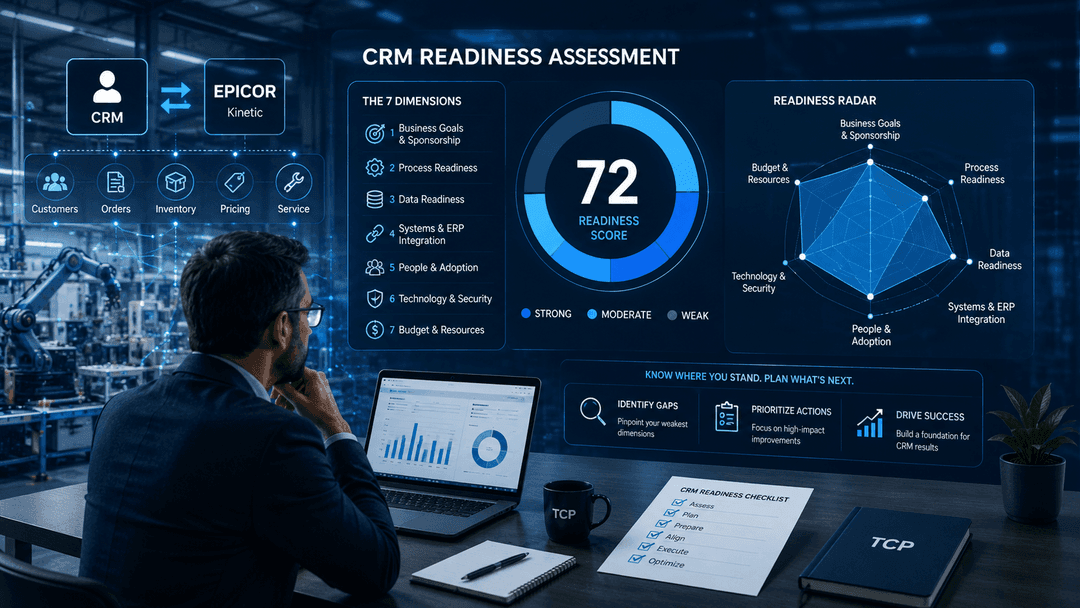
Los fabricantes que obtienen más provecho de un CRM son aquellos que evalúan su preparación antes de evaluar a los proveedores, no después. Eso suena obvio. Pero en la práctica, la mayoría de los equipos pasan directamente a las demos y a las comparaciones de características, y luego descubren a mitad de la implementación que sus datos están fragmentados, sus procesos no están documentados, o su integración con Epicor Kinetic no tiene un dueño claro.
Un CRM devuelve valor cuando tus datos, procesos, liderazgo y equipo están preparados para apoyarlo. El primer paso es una mirada honesta hacia adentro.
Este artículo te ofrece tres cosas:
- Un marco específico para fabricantes que cubre las 7 dimensiones de la preparación de CRM
- Un modelo de puntuación ponderado que revela tus brechas reales, especialmente en datos e integración con ERP
- Dos siguientes pasos claros basados en lo que revele tu puntuación, para que inicies cualquier evaluación sabiendo exactamente en qué posición te encuentras
Qué es una Evaluación de Preparación de CRM (y por qué va primero)
Una evaluación de preparación de CRM es una autoevaluación estructurada de si los objetivos, datos, procesos, sistemas, personas y presupuesto de tu organización están preparados para adoptar con éxito un CRM. No es una comparación entre proveedores. No es una lista de requisitos. Es un diagnóstico que te dice si estás listo para evaluar a los proveedores inteligentemente, y dónde necesitas prepararte primero.
La secuencia importa:
- Evaluación de Preparación - diagnosticar la preparación organizativa en todas las dimensiones
- Recolección de Requisitos - definir qué debe hacer el CRM para tus flujos de trabajo específicos
- RFP y evaluación de proveedores - puntuar a los proveedores con respecto a tus requisitos ponderados
- Implementación - ejecutar con un plan definido de integración y gestión del cambio
Omitir el paso uno no ahorra tiempo. Traslada el riesgo hacia adelante. Los equipos que preseleccionan proveedores antes de evaluar la preparación tienden a descubrir sus problemas de datos durante las negociaciones de contrato, sus brechas de integración ERP durante la implementación, y sus problemas de adopción tras la puesta en marcha.
Para los fabricantes, las apuestas son más altas que en la mayoría de las industrias. La precisión de las cotizaciones, la visibilidad de pronósticos, la respuesta de servicio y el historial de pedidos dependen de datos conectados a ERP que un CRM debe leer y escribir correctamente. Cuando esas conexiones no están claras antes de que comience la evaluación, todo el proceso de selección de proveedores se construye sobre una base inestable.
Principio rector: la gobernanza y la gestión del cambio son factores de éxito recurrentes en los programas de CRM, según ISG Buyers Guide for Customer Relationship Management 2026. El trabajo de preparación es donde comienzan ambos.
Las 7 Dimensiones de la Preparación de CRM para Fabricantes
La mayoría de las guías de preparación de CRM genéricas se quedan en tres o cuatro dimensiones, y casi nunca las ponderan. Para fabricantes que usan Epicor Kinetic, eso no es suficiente. El marco a continuación cubre las siete dimensiones que determinan si un proyecto de CRM tiene éxito o se queda estancado, y es la misma lógica de diagnóstico que aplicamos en TCP antes de que comience cualquier compromiso de implementación.
1. Objetivos empresariales y patrocinio ejecutivo
Esta dimensión pregunta si tienes objetivos medibles y un propietario ejecutivo asignado que es responsable del resultado.
Medible significa específico: visibilidad del pipeline por territorio, precisión de pronósticos dentro del 10%, tiempo de respuesta de servicio en menos de 24 horas. Objetivos vagos como "una mejor visibilidad" o "un rendimiento de ventas mejorado" no pueden evaluarse después de la puesta en marcha, lo que significa que tampoco pueden justificar la inversión.
El patrocinio ejecutivo es innegociable. Según [Tokara Solutions], más del 70% de los fracasos de iniciativas de CRM están ligados a desalineación entre funciones, y la mayor parte de esa desalineación se remonta a la ausencia de un líder único responsable en la cima.
2. Preparación de procesos
Un CRM mapea tus procesos de ventas y servicio en un sistema. Si esos procesos existen solo como conocimiento tribal, el sistema codificará inconsistencias a gran escala.
Antes de la evaluación, tu equipo debe poder describir, por escrito, cómo un cliente potencial se convierte en una cotización, cómo una cotización se convierte en un pedido, cómo un pedido activa las obligaciones de servicio, y quién es responsable de cada transferencia. Si esa documentación no existe, la definición de procesos debe ocurrir antes de la selección de proveedores, no después.
Pregunta clave: ¿Puedes guiar a un nuevo representante de ventas a través de todo tu flujo de trabajo de cotización a cierre sin depender de la memoria de una sola persona?
3. Preparación de datos
Esta es una de las dos dimensiones de mayor riesgo para los fabricantes. Un CRM hereda la calidad de los datos que le alimentas. Registros de clientes fragmentados, cuentas duplicadas, historiales de contacto incompletos y datos de cotización y pedido desconectados no se arreglarán con una nueva plataforma. Se verán amplificados por un solo factor.
Menos del 37% de los representantes de ventas usan su CRM a diario [Digitalsocius], y la calidad de los datos se cita de forma constante como una de las principales razones. Antes de la evaluación, necesitas una imagen clara de dónde viven hoy los datos de clientes, cotización, pedidos y servicio, cuál es su calidad y qué requiere un plan de migración y limpieza.
4. Preparación de sistemas e integración ERP
Para una empresa que usa Epicor Kinetic, esta es la dimensión decisiva. El CRM que elijas deberá leer y escribir datos de Epicor: registros de clientes, pedidos abiertos, precios, disponibilidad de inventario, historial de servicio y estado de RMA. Si no sabes quién es el propietario de esa integración, qué flujos de datos son necesarios y cuál es el nivel de personalización de tu entorno Epicor, no estás listo para evaluar proveedores de CRM.
Aquí es donde muchos fabricantes se quedan atascados tras la selección. El alcance de la integración se subestimó durante la evaluación porque nadie lo mapeó antes de emitir la RFP. Ese vacío cuesta tiempo, presupuesto y confianza organizacional.
5. Preparación de personas y adopción
Menos del 40% de las empresas logran más del 90% de adopción de usuarios, y la adopción, no las características, determina el retorno de la inversión. Antes de la evaluación, identifica a tus defensores internos en ventas, servicio y operaciones. Evalúa si tu equipo tiene la capacidad de gestión del cambio para respaldar un despliegue. Y sé honesto sobre la aceptación por parte de las ventas de campo: si los representantes no confían en el sistema, no lo usarán.
6. Preparación de recursos y presupuesto
El costo total de propiedad del CRM se extiende mucho más allá de la licencia. Servicios de implementación, desarrollo de integración, migración de datos, capacitación y optimización continua conllevan costos reales. Esta dimensión pregunta si tienes un propietario interno asignado con tiempo dedicado, una estimación realista del TCO y un presupuesto que cubra el alcance completo, no solo la partida de software.
7. Preparación de métricas de éxito
No puedes demostrar el valor que nunca definiste. Antes de la evaluación de proveedores, acuerda las métricas específicas que usarás para evaluar el rendimiento del CRM después de la puesta en marcha: relación de cobertura del pipeline, precisión de pronósticos, tiempo de procesamiento de cotizaciones, tasa de resolución de tickets de servicio, o lo que más dependa tu operación. Defínelas antes de comprar, o la conversación post-implementación estará impulsada por la opinión en lugar de la evidencia.
Conclusión clave: la Preparación de Datos y la Preparación de Integración ERP son las dos dimensiones que con mayor frecuencia invalidan un perfil de preparación que, por lo demás, es sólido. Puntúalas primero y dales un peso alto.
Lista de verificación de la Evaluación de Preparación de CRM: Preguntas para hacer antes de evaluar
Utiliza estas preguntas diagnósticas para autoevaluarte en cada dimensión. Están diseñadas para revelar brechas, no para reemplazar un proceso de requisitos detallado. Responde con honestidad: un "no" o "no estoy seguro" es información valiosa.
- Objetivos empresariales y patrocinio ejecutivo
- ¿Tenemos objetivos de CRM vinculados a resultados específicos y medibles para este año fiscal?
- ¿Existe un patrocinador ejecutivo nombrado que sea dueño de la iniciativa de CRM y sus resultados?
- Preparación de procesos
- ¿Nuestros procesos de ventas y servicio están lo suficientemente documentados para entregar a un consultor de CRM hoy?
- ¿Tenemos transferencias consistentes y acordadas entre los equipos de ventas, cotización y servicio?
- Preparación de datos
- ¿Sabemos dónde viven actualmente todos los datos de clientes, cotización, pedidos y servicio?
- ¿Nuestros datos están lo suficientemente limpios para migrar, o requieren primero un proyecto de limpieza?
- Preparación de la integración de sistemas y ERP
- ¿Hemos mapeado los datos de Epicor Kinetic que el CRM debe leer y escribir?
- ¿Existe un propietario designado de la integración ERP-CRM de nuestro lado?
- Preparación de personas y adopción
- ¿Hemos identificado campeones internos en ventas, servicio y operaciones?
- ¿Nuestro equipo tiene la capacidad y la voluntad para apoyar un despliegue de CRM?
- Preparación de recursos y presupuesto
- ¿Nuestro presupuesto cubre implementación, integración, migración de datos y capacitación, no solo licencias?
- ¿Existe un responsable de proyecto interno con tiempo dedicado para esta iniciativa?
- Preparación de métricas de éxito
- ¿Hemos acordado las métricas específicas que utilizaremos para evaluar el rendimiento del CRM después de la puesta en marcha?
- ¿Tenemos datos de referencia para esas métricas hoy?
Una regla práctica útil: la dirección debe entender CRM como una disciplina de procesos y datos, no solo como software [ASA Manufacturing/Distribution Assessment]. Si las respuestas de tu lista de verificación revelan que la organización aún lo ve como una compra de software, eso es una brecha de preparación antes de que se evalúe cualquier otra dimensión.
Cómo calificar tu Preparación de CRM en 2026
Una vez que hayas avanzado con la lista, convierte tus respuestas en una puntuación de preparación ponderada. Esto te da un número que puedes defender en una conversación del comité de compras y un perfil que muestra exactamente dónde enfocarte antes de que inicie la evaluación.
Paso 1: Califica cada dimensión de 1 a 5
Califica tu estado actual para cada una de las 7 dimensiones en una escala de 1 a 5:
- 1 - No iniciado o sin claridad
- 2 - Conciencia temprana, sin plan formal
- 3 - Parcialmente en marcha, persisten lagunas
- 4 - Mayormente listo, lagunas menores
- 5 - Completamente preparado, documentado y con dueño
Paso 2: Aplicar la ponderación del fabricante
No todas las dimensiones conllevan el mismo riesgo. Para los fabricantes, la Preparación de Datos y la Preparación de Integración ERP tienen un peso mayor porque una puntuación débil en cualquiera de ellas puede socavar un total, aunque sea sólido.
| Dimension | Weight | Your Score (1-5) | Weighted Score |
|---|---|---|---|
| Business Goals and Executive Sponsorship | 1.0x | ||
| Process Readiness | 1.0x | ||
| Data Readiness | 1.5x | ||
| Systems and ERP Integration Readiness | 1.5x | ||
| People and Adoption Readiness | 1.0x | ||
| Resource and Cudget Readiness | 1.0x | ||
| Success Metrics Readiness | 1.0x | ||
| Maximum possible | 40 |
Para convertirlo a una puntuación de 0 a 100, divide tu total ponderado entre 40 y multiplica por 100. CRM readiness frameworks commonly normalize to a 0-100 scale, lo que facilita comunicar el resultado entre un comité de compras.
Paso 3: Lee el perfil, no solo el total
Una puntuación total de 75, con un 2 en Preparación de Integración ERP, no es 75. Es una puntuación condicional con una brecha que bloquea. Lee primero la vista de dimensiones. Cualquier puntuación de 2 o menos en Preparación de Datos o Preparación de Integración ERP debe provocar una pausa en la evaluación hasta que se solucione esa brecha.
Umbrales de puntuación (ilustrativos):
- 80-100: Listo para pasar a recopilación de requisitos y evaluación de proveedores
- 60-79: Primero prepárese. Aborde sus dimensiones de menor puntuación, especialmente datos e integración, antes de preseleccionar proveedores
- Por debajo de 60: Aún no está listo. Invierta en trabajo de preparación antes de comprometer el presupuesto de evaluación
Descarga la Plantilla de RFP de CRM gratuita creada para fabricantes
Si tu puntuación de preparación supera el umbral, la siguiente herramienta es la Plantilla de RFP de CRM gratuita con 93 preguntas para fabricantes. Es un cuaderno de trabajo editable con lógica de puntuación ponderada creada específicamente para entornos Epicor, que cubre categorías de respuesta de proveedores desde la integración ERP y migración de datos hasta capacidades de IA, modelo de soporte y costo total de propiedad.
Empieza exactamente donde este marco lo deja: preparación primero, luego una evaluación estructurada.
Obtén tu Plantilla de RFP de CRM gratuita para fabricantes
Convierte tu puntuación de preparación en próximos pasos
Tu puntuación te dice una de tres cosas. Aquí está qué hacer con cada resultado.
Si tu puntuación es 80 o superior
Estás listo para avanzar. El siguiente paso es la definición de requisitos: traducir tus procesos documentados, necesidades de integración y métricas de éxito en un conjunto estructurado de requisitos de CRM. A partir de ahí, una evaluación estructurada de proveedores con un RFP ponderado te da un proceso de selección defendible en lugar de uno impulsado por preferencias.
Lee: CRM para fabricantes: Deja de comprar software, empieza a comprar experiencia para guiarte sobre qué priorizar en la selección de proveedores.
Si tu puntuación es de 60 a 79
Estás cerca, pero aún no estás listo para preseleccionar proveedores. Identifica tus dos o tres dimensiones con menor puntuación y aborda esas brechas primero. En la mayoría de los casos, el trabajo implica una de las siguientes:
- Limpiar y consolidar los datos de clientes y pedidos antes de la migración
- Mapear los flujos de datos de Epicor Kinetic que necesitará el CRM y asignar la propiedad de la integración
- Documentar los procesos de ventas y servicio que se configurarán en el sistema
Estos no son proyectos largos. Un sprint de preparación enfocado de 4 a 8 semanas puede pasar de 65 a un sólido 80. Pero omitir ese trabajo e ir directamente a las demos de proveedores significa pagar esas brechas más tarde, durante la implementación, cuando cuestan significativamente más arreglar.
Si tu puntuación es inferior a 60
El trabajo de preparación viene antes del gasto de evaluación. Esto no es una demora; es la decisión más rentable que puedas tomar. Los fabricantes que invierten en la preparación antes de la evaluación suelen ver plazos de implementación más cortos, mayores tasas de adopción y resultados de integración más limpios.
TCP colabora con fabricantes de Epicor justo en esta etapa. Realizamos evaluaciones de preparación antes de que los equipos se comprometan con ciclos de evaluación, de modo que el presupuesto se destine al proveedor correcto, no a recuperarse de uno desalineado.
Habla con TCP sobre una Evaluación de Preparación de CRM
Si tu puntuación revela brechas que quieres abordar con un socio experimentado antes de comprometerte con una evaluación, podemos ayudar. TCP realiza evaluaciones de preparación de CRM diseñadas específicamente para fabricantes de Epicor Kinetic: un diagnóstico estructurado que identifica brechas de datos, procesos e integración antes de comenzar cualquier conversación con proveedores.
Esto no es una demostración de producto. Es una participación consultiva diseñada para proteger tu presupuesto de evaluación y mejorar la certeza de tu implementación.
Programa una Evaluación de Preparación de CRM con TCP
Preparación en primer lugar, Evaluación en segundo
Un proyecto exitoso de CRM no comienza con una lista corta de proveedores. Comienza con una evaluación honesta de si tus datos, procesos, propiedad de la integración y liderazgo están preparados para apoyar uno.
Utiliza el marco de 7 dimensiones y el modelo de puntuación de este artículo para identificar dónde te encuentras. Corrige las brechas que bloquearían una evaluación limpia. Luego pasa a los requisitos y la selección de proveedores con confianza, sabiendo que tu organización está lista para obtener valor de la plataforma que elijas.
Una vez que sepas que estás listo, la próxima pregunta es qué CRM de fabricación elegir.
Dos rutas desde aquí:
- Si tu puntuación es sólida: Descarga la Plantilla RFP CRM gratuita de 93 preguntas para fabricantes y avanza a una evaluación estructurada de proveedores.
- Si tienes brechas que abordar primero: Habla con TCP sobre una Evaluación de Preparación de CRM creada para fabricantes de Epicor.


