
From Order Takers to Account Growers: Why Account Managers Need Better Visibility
"How do I get my account managers to stop just taking orders and start maximizing account value?" Every manufacturing sales leader has either asked this question or heard it in strategy meetings. It's one of the most common frustrations in B2B manufacturing sales.

Christian Wettre
EVP, GM North America
The Maintenance Trap
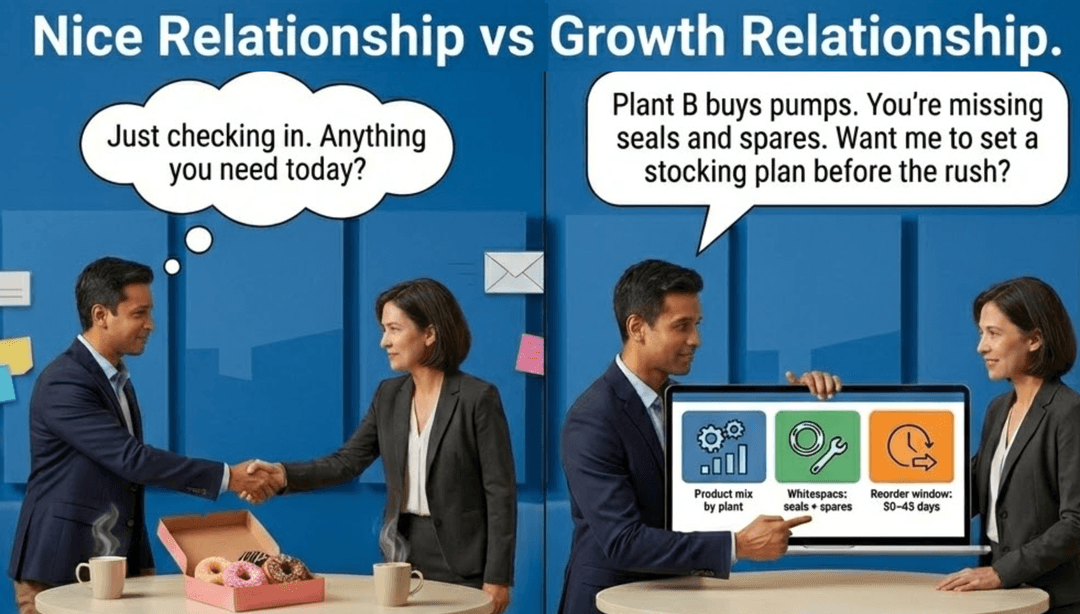
Here's the typical pattern: A sales rep has managed an account for ten years. They show up regularly with donuts. They react quickly to service issues. They check on open orders and maintain good relationships. They're busy, the customer is satisfied, and the account is being maintained.
It's just not growing.
When sales leaders see this pattern, the instinct is often to blame the rep. Maybe they've gotten comfortable. Maybe they lack initiative. Maybe they're not hungry enough to push for more business.
But in most cases, it's not a lack of effort or capability. It's a lack of easy access to the insights needed to identify growth opportunities.
The Information Gap
We ask account managers to find new opportunities within existing accounts. Cross-sell complementary products. Identify additional locations that should be buying. Expand into new product categories. Increase wallet share.
These are reasonable expectations. Growing existing accounts is more efficient and profitable than constantly acquiring new customers.
But here's the problem: the information reps need to identify these opportunities - purchase history, buying patterns, product mix by plant, reorder cycles, seasonal trends - is locked in the ERP system. A system they can't access from a customer parking lot or review before a meeting without going back to the office and requesting reports from operations.
The Common Mistake
The most common mistake mid-market manufacturers make is running excellent ERP systems in the back office while leaving the front office flying blind.
Operations, finance, and production have real-time visibility into inventory, orders, and production schedules. They can analyze data, identify patterns, and make informed decisions based on comprehensive information.
Meanwhile, the sales team - the people responsible for growing revenue and deepening customer relationships - is working from memory, instinct, and whatever fragments of information they can piece together from email threads and informal conversations.
This isn't a technology problem. The data exists. It's captured, stored, and maintained meticulously in your ERP system. It's an access problem. The people who need the data to drive account growth don't have it when and where they need it.
What Changes With Integrated Visibility
When you give account managers the visibility that comes from integrating CRM with ERP, three fundamental shifts happen in how they approach existing accounts:
They sell with facts instead of hunches. Your rep can see exactly what each customer location is buying and what it's not. If a plant is buying pumps regularly but never ordering seals or spare parts, that's not a hunch that there might be an opportunity. That's a specific, data-driven target for cross-selling. The conversation shifts from "Are you interested in our other products?" to "I notice you're buying pumps but not the maintenance parts - are you getting those somewhere else or handling it differently?"
They show up proactive instead of reactive. Instead of the generic "What do you need today?" approach, reps walk into meetings saying "Based on last quarter's usage patterns, you'll probably need to stock up on these components before your seasonal production increase." That's a trusted advisor conversation, not order-taking. The customer experiences their account manager as someone who understands their business and anticipates their needs, not just someone who shows up with donuts and reacts to problems.
They know when customers are ready to buy again. Purchase data reveals reorder patterns and replacement cycles. When your rep knows that a customer typically reorders a particular component every 90 days, and it's been 85 days since the last order, they can reach out proactively at exactly the right moment. They're not calling too early when the customer isn't ready, or too late after the customer has already placed the order with a more attentive competitor.
You Can't Grow Accounts Just by Raising Quotas
Sales leaders often try to drive account growth through goal-setting. Raise the quota. Set cross-sell targets. Emphasize account penetration in performance reviews.
These tactics might create motivation, but they don't create capability. An account manager who's motivated to find growth opportunities but can't see the data needed to identify them will spend enormous energy on low-probability activities or give up in frustration.
The more effective approach is giving your account management team the visibility they need to actually spot untapped potential in their accounts. When reps can see comprehensive purchase history, compare buying patterns across customer locations, identify product categories where the customer buys from competitors, and understand usage cycles, they can focus their energy on high-probability opportunities that are grounded in actual data.
What Would Change If Your Reps Could Actually See Account Potential?
Consider your current account management team. They already have customer relationships. They already understand the industry and the products. They're already making regular customer visits.
What would change if they walked into those visits with complete visibility into what each customer location buys, when they buy it, what they're not buying from you, and when they're likely to need to reorder?
The accounts wouldn't just be maintained. They would grow. Not because you hired different reps or implemented a new compensation plan, but because you gave your existing team the tools to identify and pursue the opportunities that were always there but previously invisible.
At TCP Americas, we help manufacturers integrate CRM and ERP systems to give account managers the visibility they need to maximize account value. By connecting solutions like SugarCRM with Epicor ERP, we enable sales teams to access comprehensive purchase history, buying patterns, and account intelligence from anywhere, transforming account managers from order takers into strategic account growers.
Your account managers want to grow their accounts. Give them the visibility to see how.
Ready to help your account managers maximize account value? Contact TCP Americas to learn how CRM and ERP integration can give your sales team the account visibility they need to identify and capture growth opportunities.


