
From Field Intelligence to Organizational Advantage: Why Sharing Matters as Much as Capturing
We have written about getting sales reps out in the field and giving them systems to capture what they learn while it's still fresh. But capturing field intelligence is only step one. Sharing that intelligence systematically across your organization is step two - and it's where the real competitive advantage emerges.

Christian Wettre
EVP, GM North America
The Distribution Problem
Your sales reps are your eyes and ears in the field. They hear about problems before they become formal complaints. They understand what customers need before it shows up in an RFQ. They spot trends across multiple accounts that signal emerging opportunities or risks.
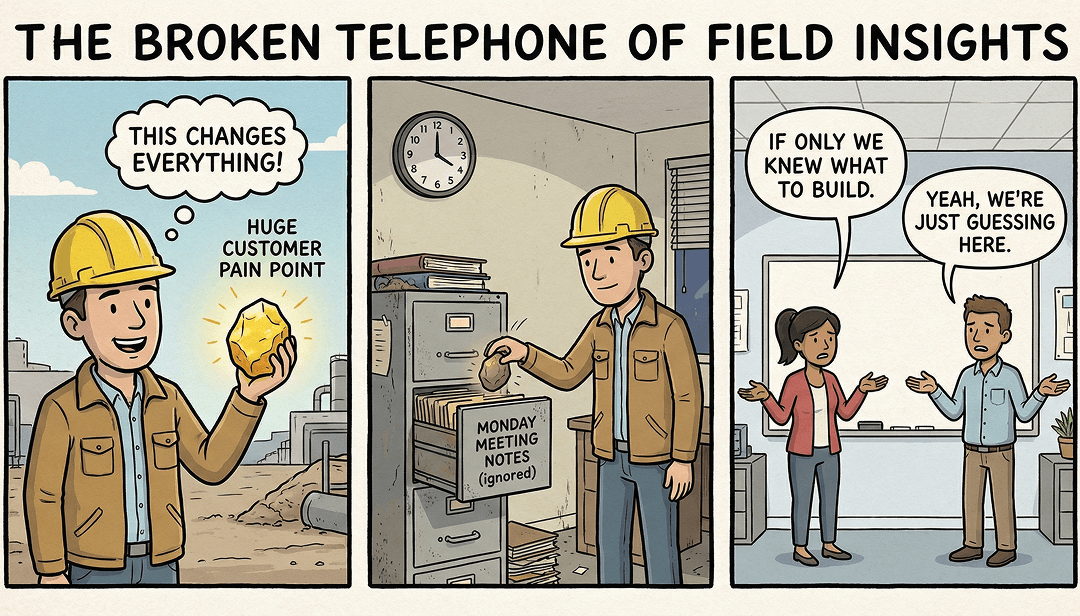
But in most manufacturing companies, that knowledge has limited distribution. Maybe Jim mentions something in a Monday meeting. Maybe he forgets. Maybe it dies in a notebook. Random acts of communication prevent your organization from leveraging the intelligence your team is already gathering.
A Question Worth Asking
If the rest of your team knew as much about your customers as your field reps do, what would change?
The answer: a lot.
What Systematic Knowledge Sharing Enables
When field intelligence flows systematically instead of randomly, every function in your organization becomes more effective:
- Product teams design better products. They're hearing real customer feedback from actual usage scenarios, not just survey data or focus groups. When your reps report that customers in three different industries are requesting the same modification, product development can prioritize features that will actually drive sales.
- Customer service teams go into calls prepared. They see what's happening across the entire account - not just the ticket in front of them. When a customer calls with a question, your service team already knows about the recent plant visit, the ongoing quote discussion, and the delivery issue that was resolved last week.
- Engineering teams catch quality issues earlier. They're not waiting for formal complaints to work their way through channels. When multiple reps report similar technical observations from different customer sites, engineering can investigate proactively before minor issues become major problems.
- Executives make sharper decisions. They're working from actual market intelligence, not guesses. When leadership discusses capacity planning, they have visibility into what reps are hearing about customers' production forecasts across multiple accounts and regions.
From Random to Systematic
The difference isn't the quality of your sales reps or the depth of their customer relationships. The difference is whether field knowledge moves through your organization by system or by luck.
Joe Towle from West Coast Metals, a manufacturing customer using integrated CRM and ERP systems, describes the impact: "The automated daily intelligence reports have eliminated my manual morning prep work, and ensure that the whole team gets the critical notes they need to start the day."
The key phrase: "the whole team gets the critical notes." Information isn't trapped in individual inboxes or mentioned randomly in meetings. It's shared systematically with everyone who needs it to do their job more effectively.
Same Reps, Same Insights, Different Outcomes
Your reps are already gathering valuable field intelligence. The question is whether your organization can actually leverage it.
When field knowledge is captured in individual spreadsheets, notebooks, and memories, only the rep who gathered it can use it. When that same knowledge is captured in integrated systems and shared automatically, your entire organization becomes smarter about your customers.
Product development becomes more market-driven. Service becomes more proactive. Engineering becomes more responsive. Leadership becomes more informed. All from intelligence your team was already gathering.
How Does Field Knowledge Move Through Your Organization?
Take a moment to assess your current state. When your sales rep learns something important in the field, how does that information reach the people who need it?
If the answer involves hoping someone remembers to mention it in a meeting, or relying on informal hallway conversations, or waiting for the rep to get around to updating a spreadsheet, you're depending on luck.
If the answer involves systematic capture in your CRM, automatic sharing through daily intelligence reports, and integration with your operational systems so the entire team has access, you've built a system.
At TCP Americas, we help manufacturers transform field intelligence from random acts of communication into systematic organizational advantage. By integrating solutions like SugarCRM with Epicor ERP, we enable field knowledge to flow automatically to everyone who needs it - product teams, service teams, engineering, and leadership.
The question isn't whether your reps are gathering valuable customer intelligence. They are. The question is whether your organization has the systems in place to share and leverage that intelligence effectively.


