
How Integrating ERP Data into Your CRM Gives Sellers Back 35% of Their Week

Christian Wettre
EVP, GM North America
Revenue may not cure every ailment in business, but it certainly covers many of them. Yet manufacturers and distributors often hamstring growth by forcing sellers to ping-pong between ERP, shipping, pricing, and Outlook for basic answers. Our recent webinar exposed that hidden drain and showed how surfacing ERP data inside SugarCRM can hand each rep back roughly one-third of their week.
The productivity gap is real
Industrial reps lose 14 hours a week hunting for information that already exists somewhere else—eight hours in system-swivel, the rest in manual re-entry and follow-up emails. That’s 35% of the week that should be spent qualifying new opportunities, chasing quotes, and deepening relationships. More importantly, it’s silent waste: management rarely sees it on a dashboard, yet it erodes pipeline velocity and morale every single quarter.
Why ERP data belongs in CRM
Buyers judge you on speed and accuracy. When a customer asks “Where’s my order?” or “Do you have stock in Phoenix?” a rep needs an instant, trustworthy answer. Embedding that ERP data in CRM means the seller sees live order milestones, open RMAs, credit status—even promised ship dates—on the same seller-friendly screen they already use to track the opportunity.
A workspace reps actually trust
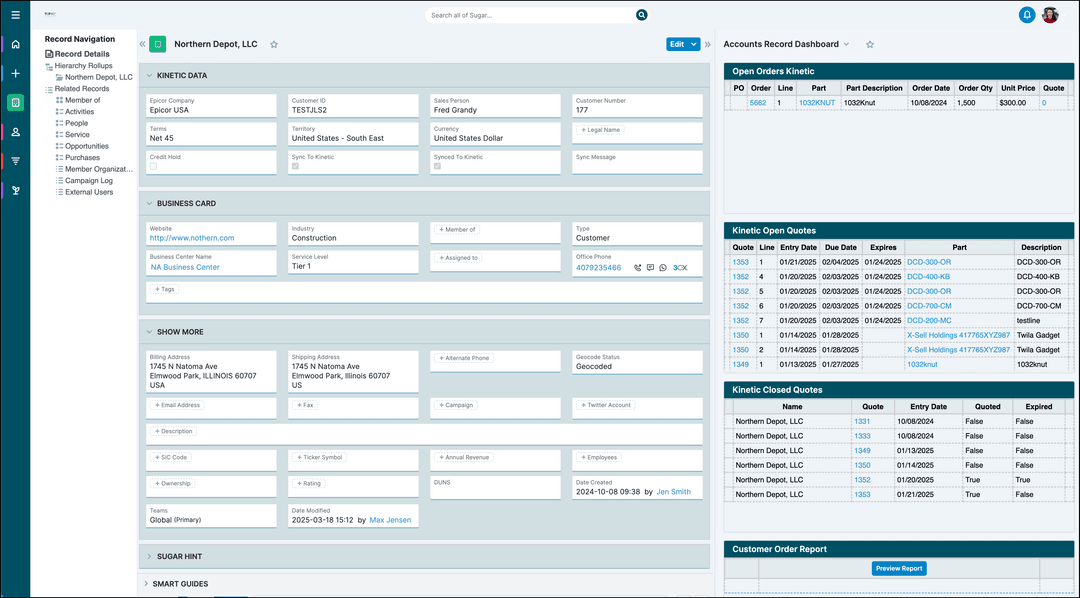
In the demo, we showed a Sugar dashboard for a metals distributor. On the left: all the account relationship information. On the right: ERP dashlets for quotes, orders, shipments, and invoices. Contextual cards translate ERP terms into sales-friendly language—for instance, turning Part 100-X avail: 725 lbs into "3 coils available to promise." Because it updates in real time, reps trust the data and stop maintaining private spreadsheets or shadow trackers.
35 % reclaimed time = real dollars
Picture a seller who now wins 20 deals a year at $50 k. Giving back 35% of the week frees eight selling hours, enough to pursue four or five extra quotes and land $200 k–$250 k in incremental revenue. Ten reps produce a $2 million swing—all before counting happier customers, faster collections, and lower churn.
Three quick wins to start
- Surface the basics. Inventory availability, order status, and tracking answer 90% of customer questions.
- Automate quote-to-cash. When a quote is approved in Sugar, push it into ERP to create the order and allocate stock.
- Give managers a live lens. With ERP-fed KPIs in CRM dashboards, leaders spot stalled quotes or credit holds without asking for spreadsheets.
The bottom line
Every minute a seller spends copying data or chasing status is a minute they’re not selling. Integrating ERP data into SugarCRM doesn’t just tidy your tech stack—it transforms productivity, compresses quote-to-cash, and uncovers revenue that’s currently hiding in plain sight. When systems talk to each other, people talk to customers. And that’s the conversation that moves the needle.
Frequently Asked Questions
When ERP and CRM systems are connected, customer-facing teams gain immediate visibility into orders, shipments, invoices, support cases, and account history. This reduces response times, eliminates communication gaps, and creates a more consistent customer experience throughout the entire lifecycle.
Manufacturers should track key performance indicators such as sales productivity, quote turnaround time, forecast accuracy, customer retention, opportunity conversion rates, average deal size, customer response times, and revenue growth. Measuring these outcomes helps organizations quantify the business value of integration initiatives.
The most valuable ERP data for sales teams includes customer order history, invoice status, available inventory, product availability, pricing agreements, credit status, shipment tracking information, and purchasing trends. Access to this information allows sellers to provide faster, more informed responses without relying on multiple departments.
Yes. Integrated systems allow organizations to analyze purchasing patterns, product usage, order frequency, and historical buying behavior. These insights help sales teams identify complementary products, service opportunities, and customer segments with strong expansion potential.
ERP and CRM integration improves forecasting accuracy by combining pipeline activity with actual purchasing history, inventory levels, production schedules, and financial data. Instead of relying solely on sales rep estimates, organizations can generate forecasts based on real operational performance, helping leadership make more informed revenue and capacity planning decisions.
Artificial intelligence can analyze integrated ERP and CRM data to identify sales opportunities, predict customer churn, recommend next-best actions, automate routine tasks, and improve forecasting accuracy. AI becomes significantly more valuable when it has access to both operational and customer-facing data sources.
ERP-CRM integration enables account-based selling by providing a complete view of customer activity across departments. Sales teams can identify cross-sell opportunities, monitor buying patterns, track product adoption, and uncover revenue gaps that may not be visible through CRM data alone.
ERP-CRM integration creates a connected technology ecosystem that eliminates information silos and improves process automation. By establishing a unified source of business data, organizations can accelerate digital transformation efforts, improve decision-making, and support future AI and analytics initiatives.
Common challenges include data quality issues, inconsistent customer records, duplicate information, disconnected business processes, and insufficient governance. Successful integrations require clear data ownership, integration planning, and alignment between sales, finance, operations, and IT teams.
Data synchronization ensures that customer, product, pricing, and transaction information remains accurate across both systems. Without synchronization, sales teams may work with outdated information, leading to quoting errors, customer frustration, and operational inefficiencies.


