
Too Long. That's How Long It Takes to Prep for a Manufacturing Business Review.
Activity across eight locations. Fifteen ship-to locations. Dozens of contacts. A pile of open opportunities and service cases spread across the entire relationship. Everything is in the CRM. But the story? It's buried. A sales director shouldn't need half a day to understand a customer relationship before a quarterly review. But that's exactly what happens when account data is scattered across individual records with no rollup, no hierarchy, and no consolidated view.

Christian Wettre
EVP, GM North America
The Problem Isn't Missing Data, It's Missing Structure
Most CRMs can store multi-location customer data. Parent accounts, child accounts, contacts tied to each. The data exists. But very few platforms make that data useful in the way a sales leader needs it: rolled up, connected, and visible at a glance.
Research backs this up. Fewer than 14% of companies have achieved a true 360-degree view of their customers, even when the underlying data is technically in the system. The gap isn't information, it's presentation. And that gap costs real time.
For manufacturers, the complexity multiplies fast. The average B2B buying committee involves nearly 7 decision-makers, and enterprise deals often touch 10 or more. Spread those contacts across multiple facilities, each with their own orders, invoices, quotes, and support history, and you've got a story that nobody can fully grasp without significant effort.
What a Real Account Hierarchy Solves
This is exactly the problem we built our Account Hierarchy for SugarCRM to address.
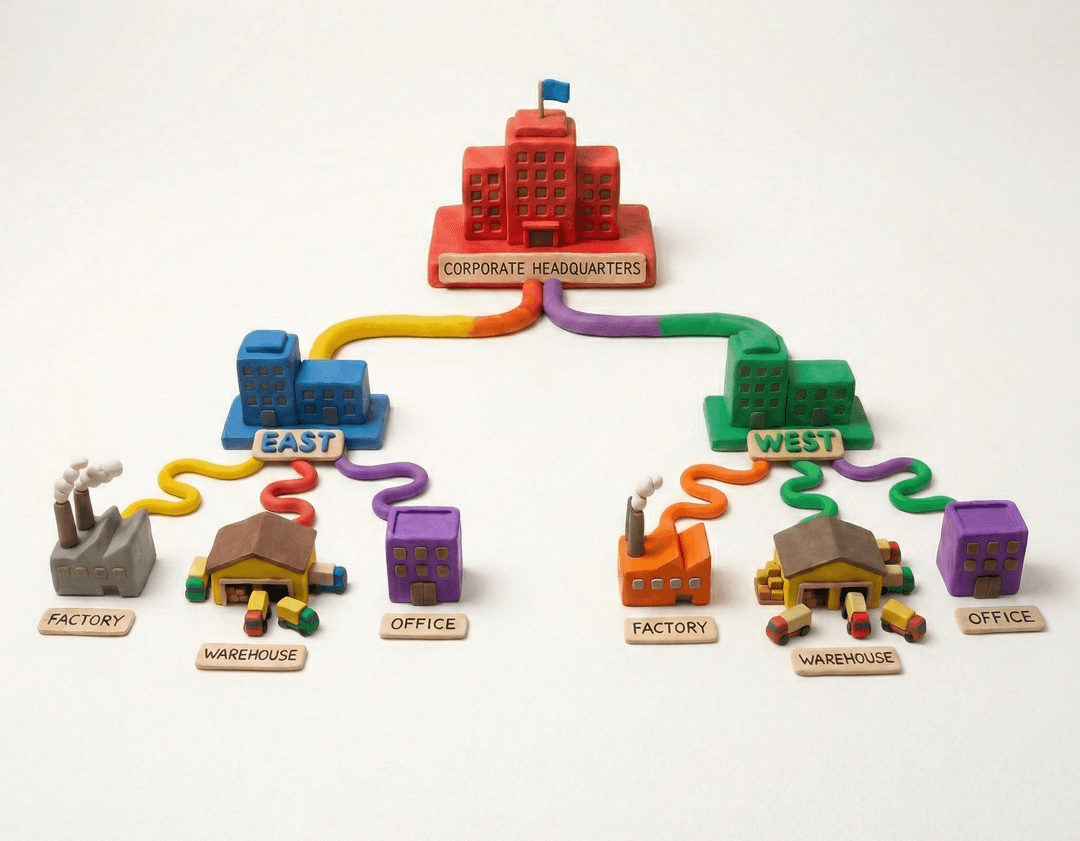
Instead of clicking into individual location records and mentally stitching together the relationship, users see the full customer hierarchy in a single view. Related information, such as revenue, opportunities, cases, and activities, rolls up into the parent account automatically.
Every location. Every contact. Every quote, order, and invoice. All rolled up and displayed on a timeline that tells the story of the relationship without requiring a research project first.
For manufacturers with complex accounts, dealer networks, and buying groups, this changes everything. Dealer and distributor hierarchies are notoriously difficult to manage. Manufacturers often can't see real-time sales and service data across their network, leading to missed opportunities and fragmented communication. A proper hierarchy view eliminates that blind spot.
If This Sounds Like Your World
You know the feeling. You've got a great relationship with a complex customer, but the story is tangled across so many records that nobody, not even your best rep, can fully articulate the health of the account without hours of prep.
Bring that messy hierarchy to us.
Our Account Hierarchy add-on for SugarCRM was purpose-built for exactly this scenario. It's part of how TCP helps manufacturers get more from their CRM investment by making the data you already have work for you.
Watch long hours of business review prep turn into a few minutes.
Frequently Asked Questions
A manufacturing business review should include a structured analysis of financial performance, operational efficiency, supply chain effectiveness, sales pipeline health, and strategic initiatives. A comprehensive review typically covers: 1. Financial Performance Revenue and gross margin trends Cost of goods sold (COGS) Budget vs. actual performance Cash flow and working capital 2. Operational Performance Overall Equipment Effectiveness (OEE) Production throughput Downtime analysis Scrap and rework rates 3. Supply Chain Metrics Inventory turns Days inventory outstanding Supplier performance On-time delivery rates 4. Sales & Demand Performance Pipeline velocity Forecast accuracy Order backlog Customer retention 5. Strategic & Continuous Improvement Initiatives Digital transformation progress Automation initiatives Lean improvements Capital investments An effective manufacturing business review consolidates ERP and CRM data into one unified performance narrative, enabling leadership to move from reactive reporting to proactive decision-making.
CRM data enhances manufacturing forecasting by connecting customer demand signals directly to production planning. Here’s how: 1. Pipeline Visibility CRM tracks open opportunities, deal stages, and probability-weighted revenue forecasts that inform production planning. 2. Customer Behavior Insights Historical buying patterns reveal seasonal trends and reorder cycles. 3. Demand Sensing Sales activity, quote volume, and engagement levels can signal future demand before orders are placed. 4. Improved Forecast Accuracy When CRM data integrates with ERP, sales forecasts automatically feed into material requirements planning (MRP). 5. Revenue Risk Identification CRM analytics highlight stalled opportunities, declining accounts, or churn risk—allowing proactive mitigation. Integrating CRM and ERP systems closes the gap between demand generation and production execution, resulting in more accurate forecasts, reduced excess inventory, and improved service levels.
Most manufacturers should conduct structured business reviews monthly, with deeper strategic reviews conducted quarterly. Monthly Reviews Operational KPIs Production targets Budget tracking Short-term demand shifts Quarterly Reviews Margin analysis Capital investments Strategic initiatives Long-term demand forecasting Annual Reviews Strategic planning Market positioning Technology investment decisions ERP/CRM optimization roadmap High-variability industries may require weekly operational reviews supported by ERP dashboards, while strategic reviews remain quarterly. Consistency is more important than frequency. Reviews must be standardized, data-driven, and aligned across departments.
ERP improves manufacturing performance reviews by centralizing real-time financial, operational, and supply chain data into a single source of truth. Key improvements include: 1. Real-Time Visibility Modern ERP systems provide live dashboards for production, inventory, and financial metrics, eliminating manual spreadsheet consolidation. 2. Data Accuracy & Consistency ERP reduces reporting discrepancies caused by siloed systems or disconnected departments. 3. Automated KPI Tracking Preconfigured dashboards track KPIs such as OEE, margin by product line, and on-time delivery without manual intervention. 4. Faster Review Preparation Instead of spending weeks compiling reports, executives can generate dynamic reports instantly. 5. Scenario Modeling & Forecasting Advanced ERP analytics allow leadership teams to simulate demand changes, supply disruptions, or cost fluctuations before review meetings. ERP transforms business reviews from backward-looking summaries into forward-looking strategic planning sessions.
The most important manufacturing KPIs measure profitability, production efficiency, supply chain performance, and demand alignment. Core KPIs include: Financial KPIs Gross margin Contribution margin by product Cost per unit EBITDA Operational KPIs Overall Equipment Effectiveness (OEE) Capacity utilization First-pass yield Scrap rate Supply Chain KPIs Inventory turnover Lead time On-time, in-full (OTIF) delivery Supplier defect rate Sales & Demand KPIs Forecast accuracy Order fill rate Backlog coverage Pipeline conversion rate Leadership teams should align KPIs to strategic objectives rather than tracking excessive vanity metrics. The goal is actionable insight—not dashboard overload.


