
How Much Does a CRM Cost for Manufacturers in 2026? A 3-Year TCO Guide
How to build a defensible 3-year CRM budget your CFO, operations lead, and IT team can all sign off on.

Christian Wettre
EVP, GM North America
The number your CRM vendor quotes and the number your CFO approves 18 months into rollout are rarely the same.
Most manufacturers walk into a CRM evaluation comparing per-user seat prices. It feels like the right starting point. It isn't.
For a manufacturing organization, the license fee is usually the smallest part of what a CRM actually costs over three years. The real budget is built from integration complexity, data migration, workflow scope, admin ownership, and adoption - and those costs vary dramatically depending on your ERP environment, your operational footprint, and how much process work was deferred before the project started.
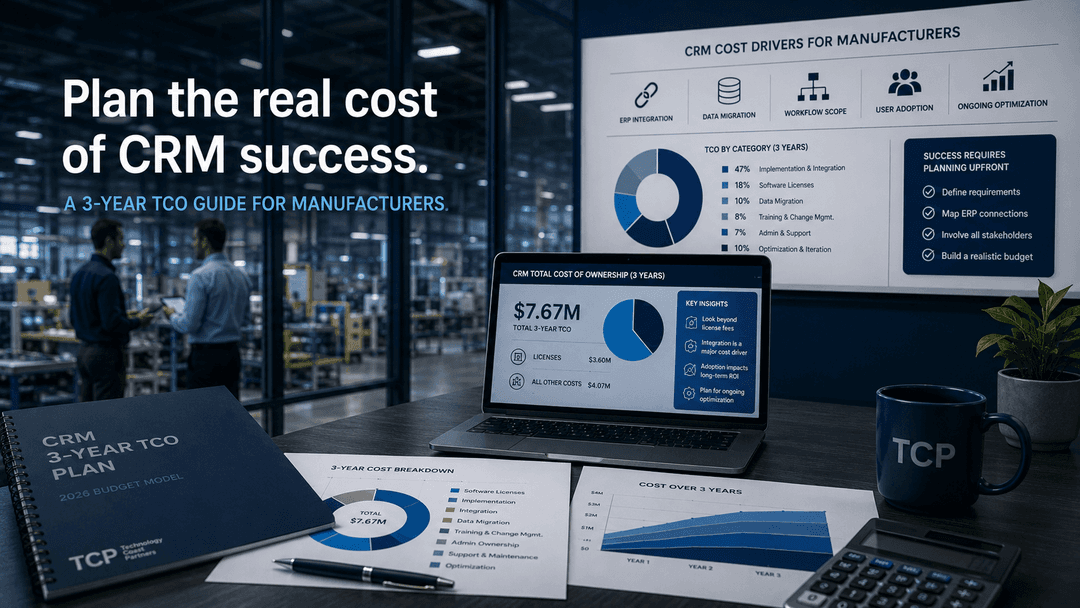
Forrester's Total Economic Impact study on Salesforce for Manufacturing puts the 3-year risk-adjusted cost at $7.67M for a composite manufacturing organization - with only $3.6M of that in subscriptions. The remaining $4.1M covers implementation, integration, change management, and ongoing administration. That split is not an outlier. It reflects how manufacturing CRM projects actually land.
What this guide covers:
- How to build a defensible 3-year CRM TCO model your CFO, operations lead, and IT lead can all stand behind
- What the 2026 pricing benchmarks actually look like across SugarAI, Salesforce, HubSpot, and Microsoft Dynamics 365
- Where manufacturing budgets expand fast - and how to see it coming before you sign a contract
What manufacturers should include in CRM total cost of ownership
A useful TCO model has to account for every cost bucket, not just the ones that appear on the vendor's pricing page. Here is the full list of what belongs in a manufacturing CRM budget.
The eight cost buckets
- Software licenses - base per-user fees, edition tiers, and any platform-level minimums
- Implementation - project management, configuration, testing, and go-live support
- ERP and systems integration - connecting CRM to Epicor, your ERP, or other operational systems
- Data migration - extraction, deduplication, field mapping, cleanup, and validation
- Training and change management - end-user training, manager enablement, and adoption support
- Admin ownership - ongoing system administration, either in-house or outsourced
- Support and maintenance - vendor support tiers, partner support retainers, and break-fix coverage
- Optimization and iteration - post-go-live enhancements, reporting builds, and workflow expansions
The biggest budgeting mistakes we see come from treating items 3 through 8 as afterthoughts. They are not. In manufacturing environments, they are often where the majority of the 3-year cost lives.
Why manufacturing is different from generic B2B CRM: Your CRM has to work alongside your ERP. Sales quotes need to reflect current BOMs and pricing. Service cases need to connect to production and inventory data. Customer records need to stay synchronized across both systems. That operational data dependency adds integration scope that a standard SaaS CRM deployment simply does not require.
Nucleus Research found that 51% of CRM ROI comes from productivity and process efficiency gains - which means a CRM that does not connect to your operations is leaving more than half of its potential value on the table.
2026 CRM pricing benchmarks: SugarAI vs Salesforce vs HubSpot vs Dynamics 365
Base license pricing across the major platforms is closer than most buyers expect at the enterprise level. The meaningful divergence happens once you layer in automation, AI features, analytics, and the integration work your manufacturing environment actually requires.
A quick note on naming: SugarCRM rebranded to SugarAI in April 2026, reflecting the platform's expanded AI and workflow automation capabilities. We use SugarAI throughout this guide.
Base license benchmarks (per user, per month)
| Platform | Entry Tier | Enterprise Tier | Notes |
|---|---|---|---|
| SugarAI | ~$49 | ~$85-$135 | Sell, Serve, and Enterprise editions; AI features included at higher tiers |
| Salesforce | ~$75 (Starter) | ~$165 (Enterprise) | Add-ons for AI, analytics, and manufacturing workflows raise effective cost significantly |
| HubSpot | ~$50 (Starter) | ~$150 (Enterprise) | Per-seat pricing plus hub add-ons; costs scale quickly with full suite |
| Dynamics 365 | ~$65 (Professional) | ~$105 (Enterprise) | Microsoft 365 licensing overlap can reduce cost for existing Microsoft shops |
Sources: Atonement Licensing 2026 CRM benchmarks; SugarCRM public pricing; vendor pricing pages.
What the table does not show
The base rates above are where vendor conversations start. They are rarely where manufacturing budgets end.
- Salesforce frequently requires additional licenses for CPQ, Service Cloud, and Manufacturing Cloud to cover quoting and service workflows. Effective per-user cost in manufacturing environments often lands well above the Enterprise headline rate.
- HubSpot pricing scales with contact volume and hub additions. A full Sales + Service + Operations suite for a mid-size manufacturer can push well past $150 per user per month before implementation.
- Dynamics 365 offers real cost advantages for organizations already running Microsoft infrastructure, but integration and customization work for non-Microsoft ERP environments adds back much of that savings.
- SugarAI packages AI-driven automation and workflow tools at the platform level rather than as add-ons, which can reduce the number of separate licenses required in a manufacturing deployment. That matters when you are building a 3-year budget.
Real-world enterprise CRM buyers on community forums consistently report landing in the $100-$200 per user per month range before implementation - which means the license line in your budget is a floor, not a ceiling.
The hidden cost drivers that change the budget fast
This is where most manufacturing CRM budgets fall apart. The license estimate holds. Everything else expands.
ERP and Epicor integration
ERP integration is consistently the biggest cost multiplier in manufacturing CRM projects. It is not just a technical connection - it touches customer master data, pricing, open orders, inventory availability, quoting logic, and service history. Every data flow requires mapping, testing, and ongoing maintenance.
The Forrester TEI for Salesforce Manufacturing found that implementation and integration alone accounted for $2.0M of the 3-year cost in their composite model - before adding $2.1M in change management and administration. That is $4.1M in non-license cost for a large enterprise. The ratio holds at smaller scale too.
Manufacturers running Epicor Kinetic face specific integration decisions: bidirectional sync vs. read-only data pull, real-time vs. batch updates, and how to handle quote-to-order handoffs between CRM and ERP without creating duplicate records or broken workflows. These are not configuration questions. They are architecture decisions that affect both cost and timeline.
Data migration
Migration cost is rarely about volume. It is about quality. A manufacturer with 50,000 clean, structured customer records migrates faster and cheaper than one with 15,000 records spread across three legacy systems, two spreadsheets, and a retiring sales rep's laptop.
Deduplication, field mapping, historical data decisions, and process redesign during migration are where timelines slip and budgets grow. Community discussions around ERP-CRM unification consistently flag data quality as the primary execution risk - not the technology.
Admin ownership
| Platform | Typical Admin Model | Annual Cost Signal |
|---|---|---|
| Salesforce | Dedicated Salesforce Admin (often full-time) | $80K-$120K+ salary or outsourced equivalent |
| HubSpot | Part-time admin or RevOps resource | Lower, but scales with customization |
| Dynamics 365 | IT-adjacent admin, Microsoft ecosystem familiarity required | Varies; higher with custom integrations |
| SugarAI | Lighter admin footprint; platform-native configuration reduces custom code dependency | Lower ongoing overhead in standard manufacturing deployments |
Scope creep
It starts with "can we add quoting?" Then field service. Then executive dashboards. Then a customer portal. Each addition is reasonable on its own. Together, they can double the implementation scope from what was originally scoped. Define your workflow boundaries before you sign - and build a change-order process into the contract from day one.
A manufacturing budgeting model: low, mid, and complex deployment scenarios
The ranges below are directional benchmarks based on published TCO studies, implementation data, and real-world buyer discussions. Actual costs depend on your architecture, data quality, and scope decisions - not on vendor marketing tiers.
These scenarios assume a 50-user deployment over 3 years.
3-year TCO ranges by deployment complexity
| Scenario | Description | Estimated 3-Year TCO Range |
|---|---|---|
| Low complexity | Single site, limited ERP integration, clean data, standard workflows, light admin needs | $150K - $300K |
| Mid complexity | ERP sync required, structured migration, quoting or service workflows, formal reporting | $350K - $700K |
| High complexity | Multi-site, bidirectional ERP integration, custom quoting, field service, heavy governance | $800K - $1.5M+ |
Ranges include licenses, implementation, integration, migration, training, and 3-year admin/support. They do not include internal labor costs for project team time.
What moves you between tiers
A few decisions have an outsized impact on where your project lands:
- Integration depth - read-only ERP data pull vs. bidirectional sync with real-time order and inventory data
- Data readiness - clean, structured records vs. multi-source cleanup and deduplication required
- Workflow scope - sales pipeline only vs. quoting, service, customer portal, and executive reporting
- Admin model - platform-native administration vs. custom code requiring developer involvement
Where SugarAI tends to fit in manufacturing
For mid-market manufacturers in the $25M-$250M revenue range running Epicor or a comparable ERP, SugarAI's architecture tends to reduce the friction in two specific areas: integration configuration and ongoing admin overhead. The platform is built with CRM-ERP connectivity as a core design assumption rather than a bolt-on, and its configuration model reduces the custom development dependency that drives admin cost on broader horizontal platforms.
That does not make it the right fit for every organization. A manufacturer already running a full Microsoft stack may find Dynamics 365 offers better total economics through existing licensing. A large enterprise with complex CPQ requirements may need Salesforce's depth. But for mid-market manufacturers prioritizing a connected, lower-overhead deployment, SugarAI's 3-year cost picture is worth modeling alongside the others before a decision is made.
The practical takeaway: The platform with the lowest seat price is not always the platform with the lowest 3-year cost. Model all three complexity scenarios before you finalize vendor shortlisting.
How to compare vendors without getting trapped by low headline pricing
The cheapest-looking CRM in the demo cycle can become the most expensive platform in year two. Here is a practical scoring framework for manufacturing buying committees.
Weighted evaluation criteria for manufacturers
| Criterion | Why it matters | Questions to ask vendors |
|---|---|---|
| ERP integration fit | Determines how much custom work is required to connect CRM to operational data | Does the platform have a native or certified connector for your ERP? What is the sync architecture? |
| Admin overhead | Drives ongoing operating cost beyond licenses | How many dedicated admin hours per week does the platform require at your scale? |
| Workflow scope coverage | Determines whether add-ons are needed for quoting, service, or reporting | What is included in the base license vs. what requires additional modules? |
| Migration support | Affects both timeline and budget risk | What does the implementation partner's migration methodology look like for manufacturers? |
| Total 3-year cost modeling | The only number that matters for a defensible budget | Can the vendor or partner provide a scenario-based 3-year TCO estimate? |
A manufacturing-oriented CRM should score well on integration fit and admin overhead before it scores well on brand recognition or UI polish. Those two criteria are where the budget risk actually lives.
Nucleus Research data supports this framing: CRM ROI is driven by adoption and process efficiency, not by feature count. A platform your team can actually use - connected to the operational data they need - will consistently outperform a more powerful platform that requires a full-time admin to keep running.
What a CFO, operations lead, and IT lead should each validate before approval
A CRM investment at this scale requires sign-off from three distinct perspectives. Here is what each stakeholder should confirm before the project moves forward.
| Stakeholder | Must validate before approval |
|---|---|
| CFO | Full 3-year cost model with license, implementation, integration, migration, admin, and support line items. Sensitivity ranges for low/mid/complex scenarios. ROI assumptions tied to specific efficiency gains, not generic vendor benchmarks. |
| Operations Lead | Workflow scope is fully defined - quoting, service, handoff, and reporting requirements documented before implementation begins. Change management plan exists. Adoption metrics are agreed upon. |
| IT / Systems Lead | Integration architecture is confirmed with the implementation partner. Migration effort is scoped against actual data quality, not estimated volume. Security, governance, and support ownership are defined in the contract. |
If any of these three columns has open questions at contract signature, the project scope - and the budget - will expand after go-live. That is not a prediction. It is the pattern we see consistently in manufacturing CRM rollouts.
Build the number before you pick the platform
A defensible manufacturing CRM budget does not start with a vendor demo. It starts with a TCO model that your CFO, operations lead, and IT lead can all validate before the first contract is signed.
The framework in this guide gives you the structure. What it cannot give you is the specificity your organization needs - the integration architecture against your actual ERP, the migration scope against your actual data, and the admin model against your actual internal capacity.
That is exactly what a CRM cost assessment is designed to produce.
At TCP, we work with manufacturers across North America and Latin America to build scenario-based 3-year CRM budgets that hold up under scrutiny - from the CFO's office to the IT review. We bring 25 years of manufacturing ERP and CRM implementation experience, a proven SugarAI implementation practice, and direct Epicor integration expertise to every engagement.
If you are building the budget case for a CRM investment - or validating an estimate that already exists - book a CRM cost assessment with our team. We will help you model the number before you commit to the platform.


