
The Value of Being a Leader: Functionality and Real Usability
But why is this distinction so important, and what makes Epicor stand out in such a competitive market?

Ivan Rebolledo
Chief Revenue Officer at TCP
Being positioned in the Leaders quadrant is not a matter of marketing, but of delivering tangible value. Nucleus Research evaluates vendors based on two critical pillars: system functionality and usability.
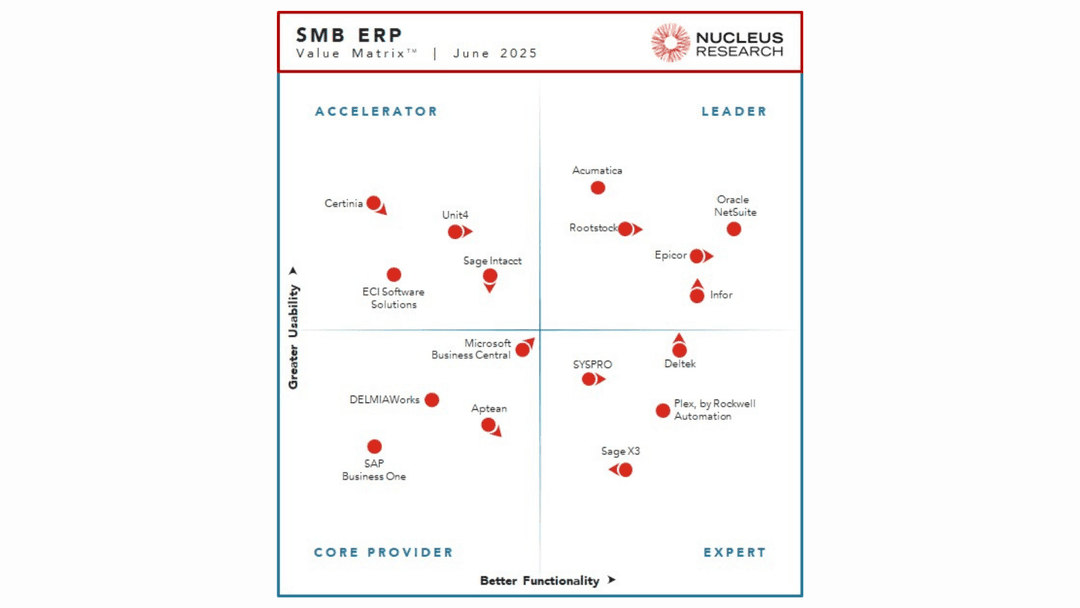
Epicor has been recognized as a Leader in the Technology Value Matrix for Small and Midsize ERP in the latest study by Nucleus Research. This recognition is due to its robust ERP platform that serves medium and large organizations in complex industries such as plastics, food, automotive, paper and cardboard, distribution, construction, manufacturing, and retail. What sets Epicor apart in the competitive ERP market is its integrated approach to financial management, supply chain management, customer relationship management, product management, project management, business intelligence, and analytics. After years of evolution and innovation, Epicor has succeeded in offering solutions that are incredibly configurable, with industry-specific ERP systems that feature low-code/no-code capabilities, pre-built API connectors, and a variety of additional composable modules that allow users to tailor their implementations to specific requirements.
The importance of occupying this leadership position in the market lies in the growing need for small and medium-sized businesses to adapt to a rapidly changing business environment. In today's complex business world, many SMBs are facing significant operational pressures, including geopolitical uncertainties, supply chain disruptions, and rising customer expectations. These companies are looking for ERPs that not only offer basic management tools, but also enable them to make informed and rapid decisions using advanced technologies such as artificial intelligence and machine learning.
Epicor has understood these needs well and responded with innovations that facilitate not only efficient management but also agile decision-making. One significant innovation is Epicor's Grow Data platform, which centralizes business data in a scalable data lake. This solution enables high-performance queries for analysis, facilitating predictive insights and improved operational efficiency, which is crucial for companies to make real-time, data-driven decisions. This type of analytical capability not only saves time, but also helps companies identify opportunities for improvement and optimization in their operations.
Epicor's leadership in this space is not only about offering a robust product, but also about its commitment to the customer experience. The company has been able to listen to the concerns of its users and adapt its service offering accordingly.
The small and medium-sized business environment is changing rapidly, and with it, expectations of what is expected from an ERP system. SMBs no longer want solutions that merely act as systems of record; they are looking for systems that provide them with a real competitive advantage, offer them the flexibility to adapt to change, and enable them to grow sustainably. In this context, Epicor, as a leader in Nucleus Research's Technology Value Matrix for ERP, can not only meet these expectations but exceed them, becoming an indispensable strategic partner for companies that want to grow and thrive in these times.
If you are among the business leaders who hold positions as chief operating officers (COOs) and plant managers, finance leaders and CFOs, supply chain professionals, or a digital strategy consultant, this report is for you.
Frequently Asked Questions
Effective leadership in modern organizations is defined by the ability to combine strategic thinking with data-driven execution. Leaders must be capable of interpreting insights from business systems, aligning teams around those insights, and driving continuous improvement. This includes fostering a culture of accountability, embracing digital transformation, and ensuring that technology investments translate into tangible business value.
Leaders can improve decision-making by using ERP and CRM systems to consolidate data from across departments into a single source of truth. This eliminates information silos and provides a comprehensive view of operations, finance, and customer activity. With this level of insight, leaders can make more informed strategic decisions, improve forecasting accuracy, and respond quickly to emerging opportunities or challenges.
Leadership has a direct and measurable impact on organizational performance by influencing decision quality, operational efficiency, and employee engagement. Leaders who rely on accurate, real-time data from integrated systems can identify inefficiencies, optimize processes, and improve productivity. This results in stronger financial performance, better customer experiences, and more predictable growth.
Leadership is essential in business because it provides clear direction, aligns teams around shared goals, and ensures consistent execution. Strong leaders create structure and accountability while guiding organizations through change. In environments supported by ERP and CRM systems, leadership becomes even more critical, as it determines how effectively technology is adopted and used to drive measurable business outcomes.
Technology plays a foundational role in leadership success by enabling visibility, speed, and precision in decision-making. Modern leaders depend on ERP and CRM platforms to access unified data across the organization. This allows them to monitor performance, anticipate risks, and respond proactively, which is essential for maintaining competitiveness in complex and fast-moving markets.


