
When Account Knowledge Lives in One Rep's Head
A practical guide for distributors whose customer context has to survive a rep transition.

Christian Wettre
EVP, GM North America
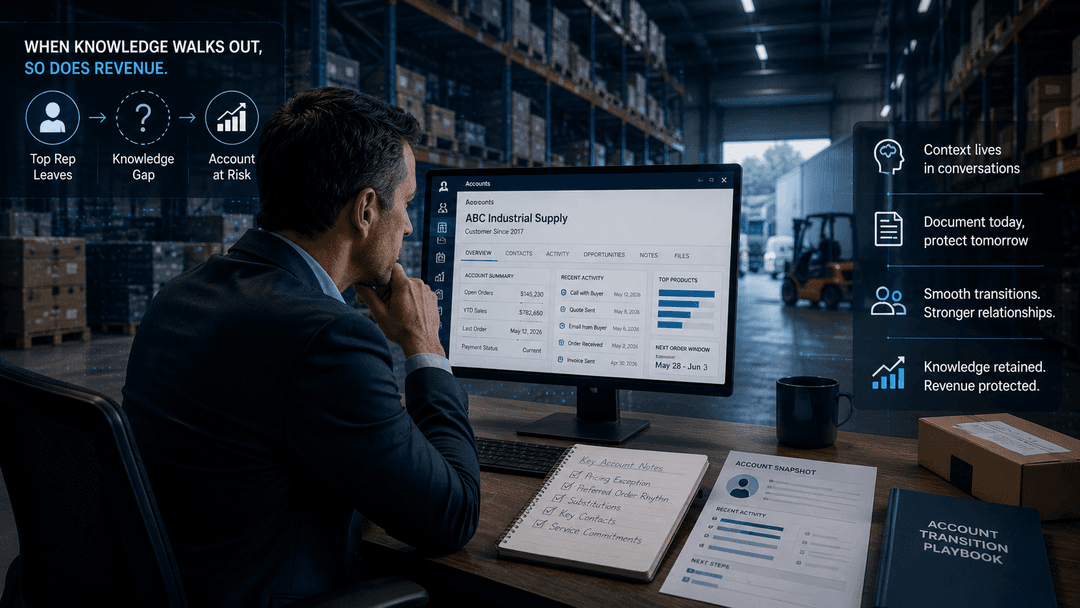
Most distributors have a CRM. The real question isn't whether the system exists. It is whether the account knowledge inside it would survive if your top rep left tomorrow.
In distribution, customer relationships carry more context than a contact record can hold. A buyer's preferred order rhythm. The substitution they accepted once and will accept again. The pricing exception that was approved two years ago and never formally documented. The branch manager they call directly when a shipment runs late. That context is what keeps accounts stable, renewals smooth, and service consistent.
When it lives in a system, it travels with the account. When it lives in a rep's memory, it walks out the door.
This article is about that gap. Not about CRM software selection in the abstract, but about a specific operational risk that distribution businesses carry quietly until a rep leaves, a territory changes, or the business grows faster than any one person can manage.
What Happens to Your Accounts When a Rep Leaves?
The immediate concern when a rep leaves is pipeline coverage. Who picks up the open opportunities? Who calls the accounts that were mid-conversation?
But the deeper problem surfaces later, usually three to six months out, when the incoming rep realizes they are missing something the CRM cannot supply.
What the system holds
A well-maintained CRM captures the visible layer of account activity: contacts, logged calls, open opportunities, recent orders. That is useful. But in distribution, it is rarely the whole picture.
What the system misses
The knowledge that actually drives account stability tends to be informal and undocumented:
- Pricing exceptions and approval history. A customer has been buying at a negotiated rate that was never formalized in the system. The new rep quotes standard pricing. The customer pushes back. The rep has no record to reference.
- Preferred order patterns. Some buyers order on a fixed cycle. Others call only when inventory drops below a threshold. The rep who knows that rhythm can anticipate it and stay ahead. The new rep waits for the call that never comes.
- Substitution agreements. A product line changed. The customer agreed to a substitute after a conversation that was never logged. The new rep ships the original SKU. The customer rejects it.
- Relationship architecture. The buyer signs the PO, but the warehouse manager controls what actually gets ordered. The rep who knew to call the warehouse manager first closed faster. The new rep calls the buyer and waits.
- Service exceptions. A customer has an informal arrangement for expedited delivery during their production peak. It is not in any contract. It existed because one rep built the relationship to support it.
None of these are exotic situations. In distribution, they are standard operating context for any account active for more than a year. And none of them survive a rep transition if they were never recorded.
The business impact is not just a slower ramp for the new rep. It is customer friction at exactly the moment when the relationship is most fragile. Accounts that were stable become accounts that are at risk, not because anything changed in the product or the price, but because the institutional memory that held them together left with the person.
Why the ERP Does Not Solve This
A common assumption in distribution is that the ERP already holds enough account knowledge to cover the gap. The logic is understandable. The ERP has every order, shipment, invoice, and return. If the history is there, what is missing?
The answer is context. The ERP records what happened. It doesn't record why, what the rep agreed to, or what the customer expects next time.
What the ERP captures well
| ERP strength | What it tells you |
|---|---|
| Transaction history | What was ordered, when, at what price |
| Shipment records | What was delivered and when |
| Invoice and payment data | What was billed and whether it was paid |
| Return and credit history | What came back and why it was accepted |
This is genuinely useful for a new rep trying to understand an account's volume and product mix. It is not useful for understanding the account's commercial relationship.
What falls outside the ERP record
The ERP does not capture the conversation where a pricing exception was agreed. It does not record that a buyer prefers to be contacted on Tuesdays, or that a particular SKU was substituted with the customer's informal approval, or that the account's procurement process changed when their parent company was acquired.
Those details live in email threads, call notes, and the rep's working memory. When the rep leaves, so does that knowledge.
This is not a criticism of ERP systems. They are designed to record operational transactions accurately, and they do that well. But a dedicated CRM built to complement the ERP is designed to hold the commercial context the ERP was never built to capture. The two systems answer different questions. The ERP answers: what did this customer buy? The CRM answers: what does this customer need, expect, and respond to?
Distributors who assume the ERP covers both questions are carrying more account-knowledge risk than they realize.
What Account Knowledge Actually Means
The term "account knowledge" gets used loosely. In distribution, it has a specific meaning, and it is worth being precise about what it includes before asking whether your CRM holds it.
Transaction history is not account knowledge. It is account data. Your ERP has it. It tells you what a customer ordered, when they ordered it, and what they paid. That is useful context, but it is not the same as knowing the account.
Account knowledge sits beneath the transaction record. It includes:
- Commercial agreements that exist outside formal contracts. Pricing exceptions approved in a sales conversation. Delivery arrangements that were never written into a service agreement. Credit terms that were adjusted once and never revisited.
- Buying behavior that is not visible in order history. A customer who always reorders in the first week of the month. A buyer who goes quiet when a budget cycle is closing and needs to be reached through a different contact. A procurement team that will not respond to email but will always pick up the phone.
- Relationship architecture. The person who signs the purchase order is rarely the one who controls what gets ordered. The rep who knows to call the warehouse manager, plant supervisor, or VP of operations closes faster and retains longer. That knowledge does not appear in any order record.
- Context about why the account is where it is. How the relationship started. What problem the distributor solved that a competitor could not. What the customer tried before and rejected. What it would take for them to leave.
None of this is captured by logging calls or updating a pipeline stage. It requires deliberate, structured capture of the kind of information that reps currently carry in their heads because no one has built a system to hold it.
The distinction matters because it defines the problem correctly. Distributors who think account knowledge means contact records will build a CRM that stores names and phone numbers. Distributors who understand that account knowledge means commercial context will build a CRM that protects the relationship itself.
The Multi-Site Problem Nobody Models
Rep turnover is the most visible version of the account-knowledge problem. But it is not the only one.
Distributors with multiple branches, territories, or sales channels face a compounding version of the same risk. Account knowledge doesn't live in one rep's head. It gets spread across teams, locations, and roles, with no shared record connecting it all.
How the problem compounds across locations
Consider a distributor with branches in three regions. A key customer has buying locations in two of those regions, each with its own purchasing contact and its own order history. The regional reps manage their slice of the account independently. No one has a view of the whole customer.
When leadership asks how the account is performing, the answer requires pulling reports from multiple sources and reconciling them manually. When the customer calls with a complaint about a shipment from a branch they do not normally deal with, the rep who picks up has no context for that location's history.
And when a regional rep leaves, the account knowledge gap isn't just local. It affects the distributor's ability to manage the customer as a whole.
What a flat CRM cannot show
Standard CRM systems store accounts as individual records. A multi-location customer becomes a wall of near-identical entries, with no way to understand the relationship as a network. Contacts, opportunities, service cases, and order history are scattered across records with no structural connection between them.
As a result, account knowledge fragments by location. Each branch knows its slice. Nobody knows the whole picture. And the customer, who expects the distributor to know them, experiences the gap as inconsistent service.
Tools like Account Explorer for SugarAI address this directly by building a visual hierarchy across the full account network, rolling up contacts, opportunities, cases, and meetings from every location into one view, and maintaining a searchable engagement timeline across the entire relationship. For distributors managing complex, multi-location accounts, that structural visibility is the difference between managing an account and managing a collection of disconnected records.
The multi-site problem is not just a reporting inconvenience. It is an account-knowledge architecture problem. And it does not resolve itself as the business grows. It compounds.
The Four-Question Test
Before evaluating any CRM platform, run a quick diagnostic on where your account knowledge actually stands today. These four questions are designed specifically for distribution businesses. Answer them honestly, and the pattern of answers will tell you whether you have a concentration risk worth addressing.
- If your top rep left tomorrow, could their replacement work the account from the system alone?
- Can you see what a customer buys from you across every one of their sites?
- Do you know what each account buys elsewhere that you also sell?
- Is every open commitment to a customer visible to someone other than the rep who made it?
If the honest answer to any of these is no, account knowledge is concentrated in people rather than in the system. The risk is real, and it grows with every rep hire, territory change, and new branch you add.
These questions are not a CRM evaluation checklist. They are a continuity diagnostic. The goal is not to score your current software. It is to locate where institutional knowledge lives in your business and whether it would survive a change.
Building a Shared Record Without Slowing the Sales Team Down
The most common objection to fixing account knowledge concentration is not philosophical. It is practical. Reps resist systems that cost them time and give nothing back.
That objection is legitimate. A CRM that requires reps to fill in structured fields after every call, log meeting notes in a specific format, and maintain account profiles on top of their selling workload is a system they abandon. The data quality degrades within weeks. The shared record becomes a collection of outdated entries that nobody trusts.
The principle that makes it work: capture at the point of work
The answer is not asking reps to do more. It is embedding capture into what they already do.
When a rep sends a follow-up email, that interaction should log automatically. When they update a quote, the pricing context should attach to the account record. When they note a customer preference in a call, the system should make it easy to record in two fields, not a paragraph, at the moment the conversation ends.
The goal is a system where doing the work and recording the work are as close to the same action as possible. Reps who experience that do not resist the system. They use it because it makes their next conversation easier.
That principle is what distinguishes a platform built for this from one adapted to it, and it is worth testing directly in any demo, including SugarAI.
Start with the top 20 accounts
Trying to build a complete shared record across the entire customer base at once is the fastest way to stall a project. Start with the accounts with the highest concentration risk: the top 20 by revenue.
For each of those accounts, document:
- Who the primary contacts are and what role they play in the buying decision
- Any pricing exceptions or approval history that is not visible in the ERP
- Preferred order patterns, service expectations, and known substitution agreements
- Relationship notes: who the rep knows, how the account was won, what keeps it stable
This is not a one-time data entry exercise. It is the foundation of a shared record that gets maintained because it is useful, not because it is required.
What good looks like at 90 days
At 90 days, a team that has started this process correctly should be able to answer yes to at least two of the four diagnostic questions above. Specifically:
- A manager should be able to pull up any of the top 20 accounts and understand the commercial relationship without asking the rep.
- A territory change on any of those accounts should be manageable without a two-week handoff conversation.
That is not a complete solution. But it meaningfully reduces concentration risk, and it is achievable in a quarter without a full CRM implementation project. The shared record starts with the accounts that matter most, and the discipline extends from there.
How to Start This Quarter
The diagnostic is clear. The path forward is concrete. Here is how to act on it before the quarter ends.
Step 1: Take your ten largest accounts by revenue. These accounts carry the highest concentration risk and the most immediate cost of losing institutional knowledge.
Step 2: Document what is known and where it lives. For each account, map the knowledge that actually drives the relationship: pricing exceptions, order patterns, key contacts and their roles, service agreements, substitution history. Then note where each piece of information currently lives. Is it in the CRM? In an email thread? In the rep's memory? In a spreadsheet on someone's desktop?
Step 3: Identify the gaps. Accounts where most knowledge lives outside the system are your highest-risk accounts. That is where a single rep departure, territory reassignment, or management change would create the most customer friction.
Step 4: Use the RFP Template to evaluate whether your current CRM can hold this. If your system cannot capture the commercial context your top accounts require, that is a platform question worth answering formally. The free 93-question CRM RFP Template covers account management depth, key account management software capabilities, and ERP integration in detail. It is built for distribution buying teams who want to run a structured evaluation rather than a demo-driven one. If you are already in active vendor conversations and want a second opinion on platform fit or integration architecture, talk to the TCP team.
This quarter's goal is not a full CRM implementation. It is a clear picture of where account knowledge lives in your business, whether your current system can protect it, and what a more capable platform would need to do differently. For a broader view of how CRM for distributors and manufacturers has evolved in 2026 and where the leading platforms fit, that guide covers the full selection landscape.
Frequently Asked Questions
The rep owns capturing it. The business owns the standard for what gets captured and the discipline of keeping it current. Making reps solely responsible produces inconsistent records, because every rep decides for themselves what matters. Making sales operations solely responsible produces clean but shallow records, because the people entering the data were not in the conversation. The workable split is that sales operations define the fields, audit completeness on the top accounts, and remove anything nobody uses. Reps fill them in as part of the work rather than as a reporting task.
Yes, up to a point, and that point is more specific than most people expect. A spreadsheet works while one person maintains it, the account list is short enough to review in a single sitting, and nobody else needs to act on it. It stops working when a second person needs to update it, when it has to reconcile against live ERP order data, or when the information in it has to survive that person leaving. That last condition is the one that matters here. A spreadsheet is a personal tool, so it carries the same concentration risk as the rep's memory.
You record the relationship as two linked accounts rather than one, because the buying entity and the consuming entity are different. The distributor holds the commercial terms and places the orders. The end customer decides what gets specified and lives with the result. Knowledge about each sits with different people, often a channel manager and a field rep who rarely compare notes. Without a structure that links them, you can see what the distributor bought and never learn why demand moved. The account hierarchy is what makes that visible, and it is the same structure multi-site customers require.
Business Central manages customer relationships through its customer and contact records and can represent related entities, but hierarchy modelling is limited compared with a dedicated CRM. Parent and child relationships across many ship-to locations, with different owners, pricing rules and service contacts at each, is where most teams find the native capability thin. The practical test is whether you can see rolled-up activity and opportunity data for a whole account network in one view, without exporting to a spreadsheet. Confirm the answer against your own version and configuration rather than assuming either way.
You estimate it, and the estimate improves as you replace assumptions with observations. No distributor sees a customer's full purchasing outside their own invoices, so share of wallet is always modeled rather than measured. Three inputs give you a usable figure: the customer's size and category profile, what comparable accounts of that size buy from you, and what the rep learns directly about competing suppliers. Recording that last input is the part most distributors skip. A CRM that captures competitor presence, lost lines, and the reason a category was never won turns a guess into a range you can act on.
Require what someone else would need to work the account tomorrow. That means the decision-making structure, agreed pricing and service exceptions, order patterns, competing suppliers, and any commitment made to the customer. Do not require call summaries, meeting minutes, or free-text activity narrative. Those consume the most rep time and are read the least. The test for any field is whether a specific person would look for it in a specific situation. Fields that fail that test are why reps stop trusting the system, and every one you remove makes the required fields more likely to be filled.
White space analysis is the process of identifying where existing customers have buying potential that has not yet been captured. In distribution, it means mapping what product categories or service lines a customer buys from you against what they could be buying, then identifying the gap. A CRM that connects to ERP order data and supports structured account planning makes white space analysis a repeatable sales motion rather than a periodic exercise that depends on one rep knowing the account well enough to see the opportunity.
Long enough that the cost appears in the customer relationship before it appears in the numbers. There is no reliable industry figure, because the answer is driven by variables specific to your business: how many accounts the departing rep held, how complex their pricing and service arrangements are, whether the rep is available during the transition, and how much of the context was ever written down. The useful measure is not elapsed time. It is how many customer conversations the new rep has to open by asking questions the business should already be able to answer.
Account planning software holds your strategy for an account. A CRM holds the record of activity on it. A CRM tells you who was contacted, what was quoted, and what was ordered. Account planning software tells you what the account is worth, where it could grow, who influences the decision, and what the plan is for the next twelve months. In distribution the two are usually the same platform, with the planning capability configured on top. The question to ask a vendor is not whether they offer account planning, but whether it is a structured, reportable layer or a free-text notes field.
Structured data migrates cleanly. Context usually does not. Accounts, contacts, opportunities and closed activity records move because they map field to field. Free-text notes, email threads, attachments, and anything held in a custom field the new system has no equivalent for are where loss happens, and it is rarely noticed until someone goes looking for a detail that is no longer there. Decide before migration which history you actually need and how far back. Then verify a sample of your largest accounts in the new system before decommissioning the old one, rather than after.


