
The FFL Bound Book for Manufacturers: Keeping ATF Records and Your ERP in Sync
Connecting acquisition and disposition records to the systems that run the plant.

Christian Wettre
EVP, GM North America
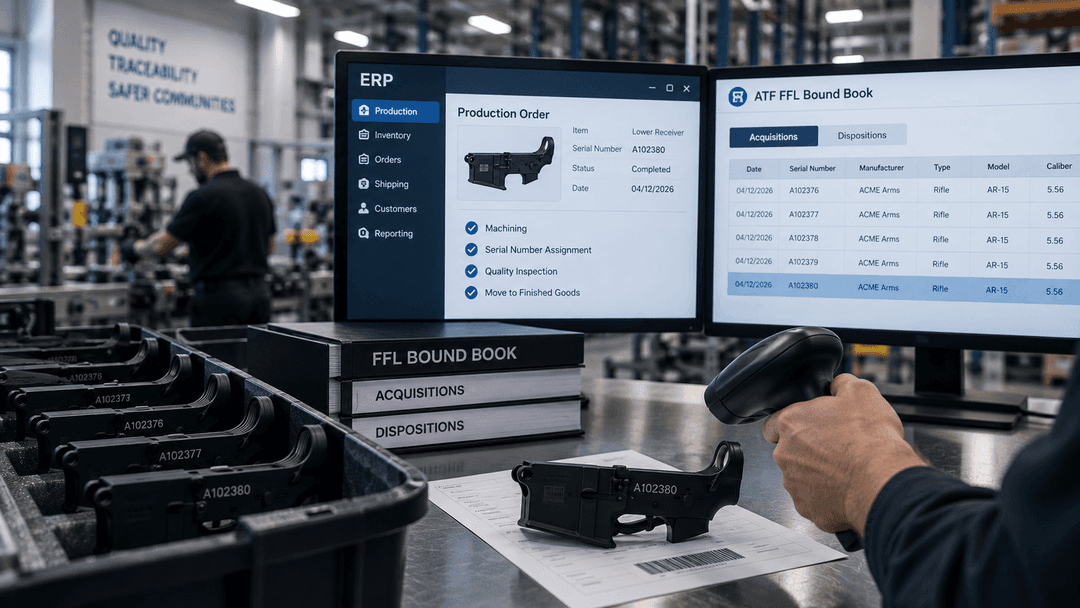
Every firearm your plant produces starts as a receiver or frame with a serial number. That serial number enters a production record, moves through inventory, travels through an order, and eventually transfers to a licensed distributor or dealer. At each step, a different system touches it: the plant floor records, the enterprise resource planning (ERP) system, the sales process, and the bound book.
The bound book has to reflect all of it. But in most manufacturing operations, it does not receive data automatically from those systems. Someone re-keys it. And every time a person re-keys a record from one system into another, the two can drift.
The Federal Firearms License (FFL) holder responsible for that record, and the Bureau of Alcohol, Tobacco, Firearms and Explosives (ATF) inspector who may review it, both need the bound book to match what the plant and the sales team actually did.
The goal is not to interpret the regulation. It is to show you the systems problem underneath it.
Three places where bound book events originate:
- The plant floor, where serial numbers are assigned and production is completed
- The ERP, where inventory moves and shipments are recorded
- The sales and customer management process, where orders are taken and licenses are verified
This article maps where each bound book field originates, identifies the points where records separate from reality, and describes what a connected recordkeeping setup looks like from the moment a serial number is assigned to the moment a shipment closes the disposition entry.
What the Bound Book Has to Capture
Under Title 27 of the Code of Federal Regulations section 478.123 (27 CFR 478.123), a licensed manufacturer must maintain a record of every firearm manufactured or otherwise acquired, and every firearm transferred or otherwise disposed of.
An acquisition entry must include:
- The name of the manufacturer and importer, if any
- The type, model, caliber or gauge, and serial number of the firearm
- The date of manufacture or acquisition
- If acquired from another party, the name and address or name and license number of the person it was received from
A disposition entry must include:
- The date of sale or other disposition
- The name and license number of the licensee the firearm was transferred to
- For a transfer to a non-licensee, the name and address of that person
Timing: Manufacture or acquisition entries must be made not later than the seventh day after the event. For firearms defined in Title 26 of the United States Code section 5845 (26 U.S.C. 5845), which covers National Firearms Act (NFA) firearms, by the close of the next business day, with a possible extension to seven days where commercial records are kept separately and are readily available. Disposition entries must be made not later than the seventh day after the transaction.
The regulation also provides that ATF's Director may authorize alternate records where they accurately and readily disclose the required information.
ATF regulations and your compliance counsel govern your specific obligations. This article describes the systems that support recordkeeping, not what the law requires you to do.
Where Bound Book Records Actually Come From
Look at each field the regulation requires and ask where it originates in your operation. The answer is never "the bound book." Every field is created somewhere else first.
Manufacturer, Type, Model, Caliber or Gauge
These fields come from your product master. In a manufacturing ERP, every finished good has an item record that carries the firearm type, model designation, and caliber or gauge. When a production order is opened, those attributes are already defined. The bound book entry does not create that data. It copies it.
Serial Number
Serial numbers are assigned at the point of manufacture, typically when a receiver or frame is marked. In most operations, that assignment happens in the ERP or in a production execution system that feeds the ERP. The serial number is a unique identifier that the inventory record, the work order, and the shipment record all carry. If it is typed again from a paper tag or a shop-floor printout, that is the first opportunity for drift.
Date of Manufacture
The date of manufacture corresponds to a production event: the completion of a work order or the transfer of a finished receiver into finished goods inventory. That event is timestamped in the ERP. The bound book entry needs to reflect the same date, not the date someone got around to entering it.
Disposition Date and Transferee Details
Disposition date comes from the shipment record in the ERP. The transferee's name and license number come from your customer record. For firearms manufacturers selling through distributors and dealers, verifying a customer's Federal Firearms License before an order is accepted is a step that happens in the sales and customer management process, not in the bound book.
The license number that enters the disposition record should be the same one your sales team verified before the order was accepted. If that information is re-typed into the bound book from a separate system, it is a third opportunity for the two records to disagree.
The point is this: no field in the bound book is born in the bound book. Every field has a system of origin. The question is whether the bound book reads from that system or receives a manual transcription of it.
Where the Records Drift Apart
Drift is not usually the result of negligence. It is the result of a process design that assumes the person maintaining the bound book will always be told, on time, about every event that generates an entry. That assumption breaks in predictable ways.
Re-Keying From Production
The most common source of drift is manual transcription. A serial number is stamped on a receiver, written on a traveler, and later typed into the bound book by someone who was not present when the firearm was marked. The receiver is the ground truth. The bound book entry is a copy. If the traveler was misread, or the entry was made from memory, the two records diverge from the first day.
Serial Number Corrections and Voids in Production
Production does not always go as planned. A serial number may be assigned to a receiver that is later scrapped. A stamping error may require a correction. A receiver may be reworked and re-serialized. Each of these events changes the production record. If the bound book was already updated with the original serial number, it now contains an entry that does not match the physical inventory. Correcting the bound book requires someone to know the production event happened, know what changed, and make the corresponding update. In a disconnected setup, that notification chain is informal and unreliable.
Shipments That Change After Disposition Is Entered
A disposition entry is supposed to reflect what actually shipped. But orders change. A shipment that was entered in the bound book as going to Distributor A may be split, held, re-routed to a different licensed entity, or partially returned. If the disposition entry was made when the order was confirmed rather than when the shipment was completed and verified, the record reflects an intent, not an event. The ERP's shipment record is the authoritative source for what left the facility and when. The bound book needs to read from that event, not from the order.
Customer License Details That Change Between Order and Shipment
A distributor or dealer's FFL has an expiration date. An order accepted in January may not ship until March. If the customer's license expires or changes between those two dates and the sales team's customer record is not updated, the license number in the disposition entry may be stale. A sound process re-checks the customer record at shipment, not only at order acceptance, so that the transferee details in the disposition entry reflect what was current when the firearm actually left the facility.
Timing Failures From Missed Handoffs
The regulation sets a timing requirement for entries. Meeting that requirement depends on the person responsible for the bound book being notified when a qualifying event occurs. In a disconnected setup, that notification is a conversation, an email, or an assumption. If production closes a work order at end of day Friday and the compliance manager learns about it Monday afternoon, the entry may still be within the window. But the process relied on a human handoff that could easily have been delayed or missed entirely. A connected setup replaces that handoff with a system event.
The common thread across all five scenarios is the same: the bound book is downstream of the systems that generate the facts it records. When those systems do not push their events to the bound book automatically, the bound book depends on people to carry the information across. People are inconsistent. Systems can be designed not to be.
What Connected Looks Like, From Receiver to Shipment
The clearest way to understand a connected recordkeeping setup is to follow one firearm through it.
Serial Assignment
A production order is opened for a specific model. The ERP assigns a serial number to the receiver. That serial number is the identifier every downstream record will carry. It exists in the system from the moment the receiver is marked, not on a tag waiting to be transcribed.
Inventory Movement
As the firearm moves through production, the ERP tracks its status. When the work order closes and the finished firearm moves into finished goods inventory, the ERP records the completion date. That date is the date of manufacture for the acquisition entry. It is already in the system.
Order and License Verification
When a distributor or dealer places an order, the sales team works from a customer record that holds the licensee's name, FFL number, and license expiration date. That verification happens before the order is accepted. If the license needs to be re-checked at shipment, the customer record is the place to do it, and the update flows forward from there.
Shipment and Disposition
When the order ships, the ERP records the shipment event: what left, when it left, and to which licensed entity. That event triggers the disposition entry. The date is the ship date from the ERP. The transferee name and license number come from the verified customer record. The entry is generated from the shipment event, not typed from a packing list.
The rule that makes this work: each record is entered once, in the system accountable for it, and every other system reads it rather than re-keys it. The connection between your ERP and your customer relationship management (CRM) system is what makes that possible at the disposition stage.
What the Bound Book Becomes
In a connected setup, the bound book is either a module within the ERP that reads directly from production and shipment records, or a dedicated electronic bound book that receives its data from the ERP rather than from manual entry. Both approaches are valid. The right choice depends on your operation, your existing systems, and whether your records meet ATF's requirements or an authorized alternate format. This article does not recommend one approach over the other.
What matters is the principle: the bound book should be the output of your systems, not a parallel record that someone maintains alongside them.
See how TCP supports firearms manufacturers across the sales, licensing, and operations workflows that feed these records.
Five Questions to Ask About Your Recordkeeping Setup
Before evaluating any software or process change, map what you have. These five questions will show you where your setup is solid and where it depends on a handoff that can fail.
1. Where is a serial number first created, and how many times is it typed after that? A good answer is: once, in the system that assigns it, and never again. Every subsequent system reads it. If the answer is "it gets typed into the bound book, the shipping label, and the order acknowledgment separately," you have identified your primary drift risk.
2. When a firearm is shipped, what triggers the disposition entry, and who is told? A good answer is: the shipment event in the ERP triggers the entry automatically, or generates a notification that requires no interpretation. If the answer is "the shipping team emails compliance," the process depends on a person remembering to send a message.
3. Where is the customer's license number held, and what happens when it expires? A good answer is: the license number lives in the customer record in your CRM or sales system, with an expiration date that generates an alert before it lapses. Understanding how CRM and ERP serve different functions in a manufacturer's sales process helps clarify where this data belongs. If the license number is in a spreadsheet or a paper file, it is not being managed.
4. If a serial number is corrected in production, how does the bound book learn about it? A good answer is: the correction in the production record propagates to the bound book record automatically, or generates a required correction workflow. If the answer is "someone calls compliance," the correction may or may not happen before the next inspection.
5. If you changed your ERP or bound book tomorrow, would the history move with it? A good answer is: yes, because the records are structured data that can be exported, mapped, and imported. If the answer is "it's in a paper book" or "we'd have to re-enter everything," you have a long-term risk that a system change will create a gap in your history.
Where to Start
You do not need new software to start this work. You need a field map.
Take every field the bound book requires and write down which system in your operation creates it first. Then find every point where a person copies that field from one system into another. Those copy points are your handoff risks. Fix the handoffs before you buy anything.
When you are ready to talk through what that mapping looks like across your ERP, your customer management system, and your current recordkeeping setup, TCP works with firearms manufacturers on exactly this kind of systems work.


