
Epicor Kinetic vs Epicor ERP: What’s the Difference?

Gonzalo Nuñez
President & CEO
Understanding Epicor Kinetic vs Epicor ERP requires clarifying product naming, platform evolution, and the evolution of Epicor's ERP offering over time. Many organizations evaluating upgrades or researching ERP platforms encounter conflicting terminology. This article provides a structured explanation of the relationship between Epicor ERP and Epicor Kinetic, outlining what changed, what remained consistent, and how organizations should interpret the transition.
Quick answer:
Epicor ERP is the long-standing enterprise resource planning platform developed by Epicor for manufacturing and distribution businesses. Over time, Epicor ERP evolved through multiple versions and architectural updates.
Epicor Kinetic is the current generation of Epicor ERP.
It is not a separate or competing product. Rather, Epicor Kinetic represents the modernized interface, deployment strategy, and architectural direction of the same ERP platform lineage.
When organizations compare Epicor Kinetic vs Epicor ERP, they are typically comparing earlier versions of Epicor ERP to its current generation, branded as Kinetic. The core ERP engine, manufacturing logic, and module structure remain part of the same product family.
In practical terms, Epicor ERP was renamed and repositioned as Epicor Kinetic to reflect modernization in user experience, browser delivery, and cloud alignment.
Why people are confused about Epicor ERP and Kinetic.
Confusion about the difference between Epicor ERP and Kinetic stems primarily from name changes and overlapping terminology.
First, Epicor ERP was the established name for many years. Organizations implemented Epicor ERP 9, and later Epicor ERP 10, and internal documentation, contracts, and training materials continue to reference that terminology.
Second, when Epicor introduced Kinetic, it did not discontinue the ERP foundation. Instead, Epicor Kinetic became the new branded generation of Epicor ERP. This resulted in both terms appearing simultaneously in documentation, partner communications, and customer discussions.
Third, many organizations remain on earlier versions of Epicor ERP. As a result, “Epicor ERP” often refers informally to pre-Kinetic versions, even though Kinetic is technically the latest Epicor ERP version.
Market messaging further contributes to ambiguity. Product pages and partner sites sometimes reference both Epicor ERP and Epicor Kinetic, reinforcing the impression of two separate products.
Finally, upgrade paths blur the distinction. An Epicor Kinetic upgrade is typically an upgrade within the same product family, but the branding shift makes it appear more substantial than a standard version update.
Epicor ERP product evolution
Major platform generations
Epicor’s ERP platform has evolved through several major generations, each reflecting architectural and interface modernization while preserving the underlying manufacturing and distribution functionality.
- Epicor 9 represented a traditional client-based ERP architecture with Windows-based interfaces and on-premises deployment as the dominant model.
- Epicor ERP 10 introduced significant architectural modernization, including a more service-oriented framework and expanded support for web-based access. It unified multiple Epicor product lines under a consolidated ERP platform.
- Epicor Kinetic represents the next evolution, focusing on browser-first delivery, cloud readiness, updated user experience frameworks, and a more flexible customization model.
Importantly, these were not separate ERP systems built from scratch. Each generation is built on the same foundational data model, manufacturing logic, and module structure.
Epicor ERP versions progressed incrementally, modernizing the platform while maintaining continuity in core business processes. Kinetic continues this trajectory by shifting emphasis toward user experience modernization and cloud deployment strategy.
Thus, Epicor Kinetic is best understood as the current stage in Epicor ERP’s evolution rather than a replacement platform.
Epicor ERP vs Epicor Kinetic comparison:
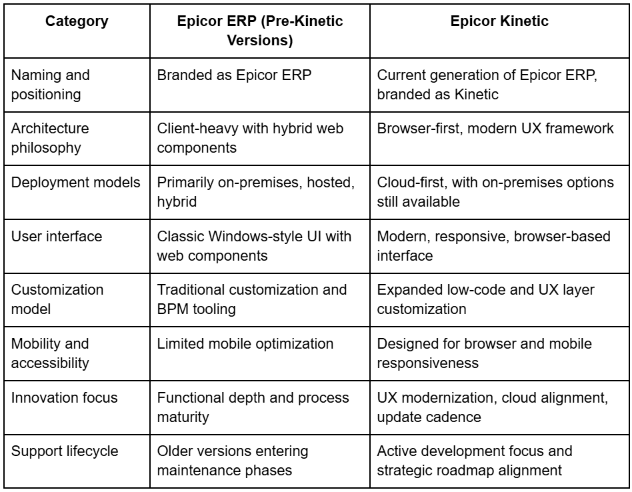
The most visible difference between Epicor ERP and Kinetic is in their user interfaces and delivery models. Kinetic prioritizes browser access and a modernized UX framework, whereas earlier versions of Epicor ERP relied heavily on installed clients.
Architecturally, however, the platform foundation remains consistent. Organizations upgrading to Kinetic are not replacing their ERP logic but modernizing how users interact with the system and how updates are delivered.
What Epicor changed when introducing Kinetic
When Epicor introduced Kinetic, the shift was conceptual as much as technical.
The most noticeable change was the user experience framework. Kinetic introduced a redesigned, browser-based interface built around responsive layouts and configurable workspaces. This marked a departure from traditional Windows client dependency.
Epicor also emphasized a cloud-first strategy. While on-premises deployment remains supported, Kinetic’s architecture and roadmap align more directly with cloud delivery models. This affects update cadence, infrastructure management, and scalability planning.
The customization approach evolved as well. Earlier versions of Epicor ERP relied heavily on traditional customization methods and business process management tools. Kinetic expands the low-code customization model at the user interface layer, enabling configuration without deep code modifications.
Update cadence also shifted. Kinetic is designed to accommodate more frequent updates, particularly in cloud deployments. This reflects broader ERP market trends toward continuous improvement rather than infrequent, major upgrade cycles.
In summary, the difference between Epicor ERP and Kinetic lies primarily in their delivery philosophies and modernization directions rather than in fundamental ERP capabilities.
What remains the same between Epicor ERP and Kinetic
Despite branding changes, substantial continuity exists.
The manufacturing logic remains consistent, including shop floor integration components such as Epicor Advanced MES. Core modules such as financial management, supply chain management, planning and scheduling, production management, and quality management operate on the same foundational principles.
The data model and business process structure remain aligned. Organizations upgrading from earlier Epicor ERP versions to Kinetic retain their master data structures, transactional logic, and core workflows.
Modules and functional scope continue within the same ERP lineage. This continuity extends to analytics capabilities such as Epicor Grow business intelligence, which integrates within the broader Epicor ecosystem. Financial planning extensions such as Epicor FP&A continue to operate within the same architectural foundation. Kinetic does not remove manufacturing depth; it modernizes how that depth is accessed and configured.
For organizations evaluating Epicor Kinetic, it is important to recognize that the platform's foundation is not replaced. The upgrade affects interface, deployment posture, and modernization strategy, but not the ERP’s manufacturing DNA.
Do Epicor ERP customers need to move to Kinetic?
When upgrading to Kinetic makes sense
An Epicor Kinetic upgrade typically makes sense when organizations:
- Seek improved browser-based accessibility
- Plan for cloud migration or infrastructure modernization
- Want to align with Epicor’s forward development roadmap
- Intend to reduce dependency on legacy client interfaces
- Require improved mobility and remote access
Kinetic aligns more closely with current enterprise IT strategies, emphasizing cloud readiness, UX standardization, and continuous update models.
When upgrading may not be immediate
An immediate move may not be required when:
- The current Epicor ERP version remains within active support
- Customizations are deeply embedded and require structured refactoring
- Infrastructure constraints limit near-term modernization
- Business disruption risk outweighs near-term benefits
The decision should not be driven solely by branding. Since Epicor Kinetic vs Epicor ERP represents evolutionary progression rather than platform replacement, organizations should evaluate timing based on lifecycle status, infrastructure strategy, and operational readiness.
There is no universal mandate to upgrade immediately. The decision should align with the broader ERP governance strategy.
Common misconceptions about Epicor ERP and Kinetic
- Misconception 1: They are separate products. Epicor Kinetic is not a separate ERP. It is the current generation of Epicor ERP under a new brand identity.
- Misconception 2: Moving to Kinetic requires full reimplementation. In most cases, upgrading to Kinetic is an upgrade path within the same platform lineage. It does not inherently require a full reimplementation unless business transformation is desired.
- Misconception 3: Kinetic is cloud-only. Kinetic supports cloud deployment, but on-premises and hybrid models remain available depending on organizational strategy.
- Misconception 4: The classic UI disappears immediately. Transition strategies typically allow phased adoption of the new interface. Organizations can manage user transition over time rather than switching abruptly.
- Misconception 5: Functional capabilities are completely new. While enhancements exist, Kinetic builds on the same ERP foundation. The core modules and manufacturing capabilities remain consistent.
Summary:
The distinction between Epicor Kinetic and Epicor ERP is primarily one of evolution, not competition.
Epicor ERP represents the longstanding platform lineage serving manufacturing and distribution businesses. Epicor Kinetic is the current generation of that same ERP system, emphasizing browser delivery, cloud alignment, and a modernized user experience.
Understanding this relationship clarifies upgrade decisions, lifecycle planning, and terminology validation. Organizations evaluating Epicor versions should interpret Kinetic as the forward-looking continuation of Epicor ERP rather than a separate product category.


