
MES vs ERP: When an Epicor Kinetic Manufacturer Needs Both
Where Kinetic stops on the shop floor, and what an MES adds.

Gonzalo Nuñez
Chief Technology Officer
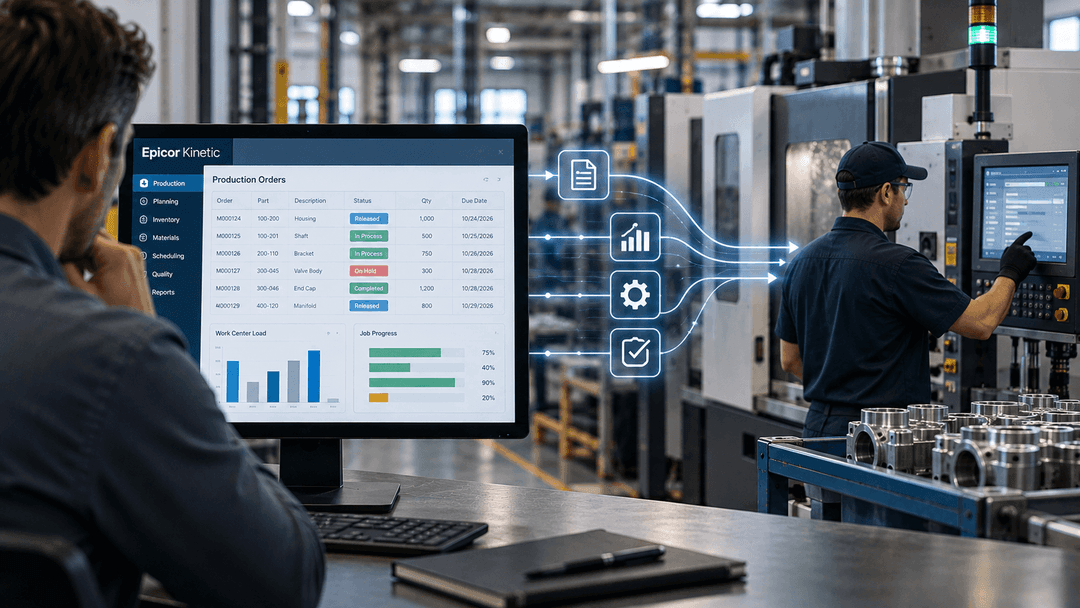
If you are running Epicor Kinetic and someone asks whether you need a manufacturing execution system, the question sounds straightforward. It is not. The MES vs ERP debate that fills the search results was written for manufacturers still choosing a platform, not for a plant that already has Kinetic recording production orders, routing instructions, and job progress. Your decision is narrower and more practical: how much of the shop floor should Kinetic carry on its own, and at what point does a dedicated MES change what you can see and act on?
This guide is written for the operations or plant leader making that case. It covers where Kinetic's reporting reaches its limits, the conditions that signal a plant has grown past them, what Epicor Advanced MES adds when those conditions are present, how the two systems share data, and what to resolve before adding an MES. If your Kinetic reporting is giving you what you need, this guide should confirm that. If it is not, it will tell you what to look at next.
MES vs ERP: Where the Line Sits in a Kinetic Plant
The standard answer to the MES vs ERP question is that an ERP manages the plan and an MES manages execution on the floor. Kinetic holds the production orders, bills of materials, routing instructions, and resource allocations. A manufacturing execution system captures what actually happens against that plan: machine runtime, labor and job status, scrap, yield, and work in progress. For the full definition of where those boundaries sit, the Epicor Advanced MES product page covers the distinction in detail.
But for a plant already running Kinetic, the relevant question is not which category of system to choose. It is how much of the shop floor Kinetic should carry on its own before a separate execution layer becomes worth the investment, the integration work, and the change to how operators and supervisors interact with production data.
Kinetic is not a passive system on the floor. It records operator transactions, tracks job progress, and gives schedulers and plant managers a view of what is planned and what has been reported. For a range of operations, that is enough. The decision to add an MES is not a verdict on Kinetic's adequacy as an ERP. It is a question about whether the plant needs a level of real-time, machine-connected visibility that operator-entered reporting cannot reliably provide.
That distinction matters because the answer is not the same for every plant. A job shop where supervisors know every machine and every operator, and where the production mix is stable enough that manual reporting keeps up, may have no gap worth closing. A plant where machines run continuously, where quality problems need to be caught in the run rather than after it, or where scheduling decisions depend on knowing what is happening on the floor right now is in a different position. The sections that follow are designed to help you locate yourself in that range.
What Kinetic Already Records on the Shop Floor
Kinetic is built to receive operator-entered production data. On the shop floor, that means operators clock in and out of jobs and operations, report quantities completed, and log labor hours. Supervisors and schedulers can see job progress as operators report it, and that data flows into costing, inventory, and production reporting inside Kinetic.
For plants where operator reporting is timely and disciplined, this gives a workable picture of what is happening on the floor. Jobs move through operations, labor gets posted, quantities get confirmed, and the ERP reflects a version of production that is close enough to reality to support planning and costing decisions.
What operator-entered reporting depends on
The accuracy of everything Kinetic records in this mode depends on one thing: operators entering data promptly and correctly. That is not a criticism of Kinetic. It is the structural condition of any system that relies on manual input at the point of production.
When an operator clocks out of an operation, Kinetic knows the job moved. When a quantity is confirmed, Kinetic updates the job. When scrap is reported, it enters the record. But none of that happens until someone enters it. The gap between when something occurs on the floor and when it appears in Kinetic is the gap that operator-entered reporting creates.
What this means for the decision
For some plants, that gap is acceptable. Reporting happens at natural break points, supervisors verify entries, and the data in Kinetic is close enough to current that decisions get made on it without significant delay or error.
For others, the gap is the problem. Machines run between operator check-ins. Quality conditions develop during a run, not just at the end. Downtime happens and gets explained after the fact, if at all. Scheduling decisions get made on data that is already out of date by the time it is entered.
Whether Kinetic's operator-entered reporting is enough is not a question about the system. It is a question about how your floor actually runs, how quickly information needs to travel from the machine to the decision, and whether the delay built into operator-entered reporting is costing you something you can measure.
Signs a Plant Has Outgrown Operator-Entered Reporting
No single condition tells you that your plant needs an MES. What follows are the signals that operator-entered reporting has reached its limit in a Kinetic environment. Each one is a decision problem, not just a data problem.
Downtime reasons arrive late or not at all
A machine stops. Production pauses. Someone eventually enters a reason, or no one does. By the time the downtime record appears in Kinetic, the shift has moved on and the supervisor who might have acted on it is dealing with something else.
The decision this blocks: you cannot address a downtime pattern you cannot see in real time. Identifying whether a machine is stopping for the same reason repeatedly, and whether that reason is mechanical, material, or operator-related, requires data that arrives while the condition is still correctable. When downtime reasons are entered after the fact, or not entered at all, the pattern is invisible until it shows up in costs or missed deliveries.
The schedule is out of date before it is acted on
A production schedule built on Kinetic's job progress data is only as current as the last operator entry. If entries happen at shift end, the schedule a supervisor is working from mid-shift reflects conditions from the start of the shift.
The decision this blocks: schedule adjustments that depend on knowing what is actually running, what is behind, and what capacity is genuinely available cannot be made on data that no longer reflects the floor. Supervisors compensate by walking the floor and asking, which turns the schedule into a reference document rather than an operational tool.
Scrap and quality problems surface after the run
An operator finishes a batch and reports scrap at the end. Or a quality check at a downstream operation reveals a problem that started earlier in the run. The material is already processed. Rework or scrap is the only option.
The decision this blocks: catching a quality condition mid-run requires visibility into what is happening during the run, not a report of what happened. When quality data enters Kinetic only at reporting points, the window to intervene closes before anyone knows it was open.
Job costs do not match what happened
Kinetic's job costing depends on accurate labor entries, correct quantity confirmations, and scrap reporting that reflects reality. When operators round their time, batch their entries, or skip reporting steps under production pressure, the cost that posts to the job drifts from what the job actually consumed.
The decision this blocks: costing accuracy is not just a finance problem. If your quoted costs are built on standard times and your actual costs are built on operator entries that do not reflect how the job ran, the gap between the two is invisible until margin analysis reveals it. By then, the pricing decision has already been made.
Supervisors spend their time chasing status
If the answer to "where is job X right now" requires a supervisor to walk to the floor, ask an operator, or check a whiteboard, the information architecture is not serving the operation. That is not a workflow problem. It is a data latency problem.
The decision this blocks: a supervisor who is gathering information cannot be acting on it. Time spent confirming status is time not spent on the decisions that status is supposed to support: adjusting priorities, addressing quality conditions, reallocating labor, or escalating a schedule risk before it becomes a delivery failure.
None of these conditions means an MES is automatically the right answer. A plant with strong operator discipline, a stable mix, and short enough feedback loops may find that the conditions above do not apply or do not rise to the level of a problem worth solving with additional technology. But if these conditions are present and are affecting decisions that matter to the business, they are worth examining against what an MES can change.
What Epicor Advanced MES Adds
Epicor Advanced MES "acts as the operational control layer between the factory floor and the ERP system." That positioning is precise: it does not replace Kinetic, and it does not duplicate what Kinetic already does. It fills the space between the machine and the ERP record, capturing what operator-entered reporting cannot.
Here is what that means in practice for a Kinetic plant, drawn from the Epicor Advanced MES product page.
Machine and sensor data capture
Advanced MES "automatically capture[s] data from machines and sensors on the shop floor." This is the foundational difference from operator-entered reporting. Data does not wait for an operator to clock out or confirm a quantity. It arrives from the equipment itself.
The decision this enables: when machine data arrives continuously, downtime reasons are recorded when they occur, cycle times are captured at the machine level, and the gap between what happened and what Kinetic knows closes. A supervisor can act on a condition that is happening now, not one that was reported after the fact.
Real-time visibility into underperforming machines
Advanced MES lets you "find out in real time when a machine is not running efficiently." The system "collects data directly from equipment and operators on the shop floor in real time."
The decision this enables: a plant manager who can see which machine is underperforming right now can make a different set of decisions than one who finds out at the end of the day or the end of the week. Reallocation, maintenance escalation, and schedule adjustment all become faster when the signal is live rather than retrospective.
Statistical Process Control and Statistical Quality Control
Advanced MES supports "Statistical Process Control (SPC) and Statistical Quality Control (SQC)" using real-time data. Quality monitoring happens during the run, not after it.
The decision this enables: in-process quality control depends on data that arrives while the process is still running. SPC and SQC allow a plant to detect a developing quality condition before the batch is complete, which is a different kind of intervention than reviewing scrap at the end of an operation.
Dynamic scheduling adjusted to floor conditions
Advanced MES provides "real-time, dynamic production scheduling that adjusts automatically to shop floor conditions." The schedule responds to what is actually happening on the floor, not to what was planned before the shift started.
The decision this enables: a schedule that adjusts to actual machine availability, actual job progress, and actual capacity gives supervisors and planners a tool they can act on rather than a baseline they have to manually correct throughout the day.
Talk to TCP about MES for your Kinetic plant
How MES and Kinetic Share Data, and Who Owns What
The data relationship between Kinetic and Advanced MES follows a clear direction. In an Epicor environment, "ERP creates the plan" and "MES executes and monitors the plan." Kinetic holds the production orders, bills of materials, routing instructions, and resource allocations. Advanced MES captures machine runtime and downtime, labor and job status, scrap, yield and quality, and work in progress. That data flows back to Kinetic for production reporting, inventory, costing, and job status.
The architecture is designed so the two systems reinforce each other rather than conflict. But making that work in practice requires decisions on the Kinetic side before the MES is connected.
What Kinetic must hold before the MES can measure against it
An MES measures actual production against a plan. For that comparison to be meaningful, the plan in Kinetic has to reflect how the floor actually runs.
That means routings and operations need to describe the real sequence of work, not an idealized or outdated version. Work centers and resources need to match the actual machines and labor groups on the floor. Standard times do not need to be exact before go-live; they can start as estimates and be corrected from MES actuals as the system accumulates data. But the structure has to be right. If an operation in Kinetic does not correspond to a real step in the process, the MES has nothing credible to measure against.
Plants that have let routings drift, consolidated operations for convenience, or built work centers that no longer reflect how the floor is organized will need to address that before the MES can produce reliable data. That is not an MES implementation problem. It is a Kinetic data quality problem that the MES makes visible.
Deciding which system is the record for each piece of data
When both Kinetic and Advanced MES are active, some data will exist in both systems. Job status, labor, and quantities will be reported through the MES and flow back to Kinetic. The question is which system is authoritative for each data element, and what happens when they do not agree.
This is not a technical question the integration resolves automatically. It is a governance decision the plant has to make before go-live. Which system do supervisors look at for job status? Which system does scheduling use? Which system does finance use for costing? The answers need to be settled in advance, not discovered after the systems are live.
Deciding who owns the MES inside the plant
An MES sits at the intersection of operations, quality, and IT. Each function has a stake in how it is configured and how it is used. Operations wants visibility and scheduling response. Quality wants in-process data and SPC triggers. IT wants stable integrations and maintainable configurations.
Without a clear internal owner, configuration decisions that require someone to make a call have nowhere to go. That owner does not have to be a single person, but accountability for the system's performance and its data needs to sit somewhere specific before the project starts.
What to Settle Before Adding an MES
Adding an MES to a running Kinetic environment is not a plug-in decision. Settle these questions before the project starts, not during it. The checklist below is for the operations or plant leader building the internal case.
Define the problem the MES must solve. Not the general category of problem, but the specific condition in your plant that operator-entered reporting cannot address. Is it downtime visibility? In-process quality? Scheduling accuracy? Job costing fidelity? The more precisely you can name the problem, the more clearly you can evaluate whether an MES solves it, and the more credibly you can measure whether it did.
Identify the machines and lines that go in first. An MES does not have to cover the entire floor at once. Starting with the lines where visibility is limited, or where the cost of a quality or downtime event is highest, reduces the scope of the first phase and gives the project a defined success condition.
Audit the Kinetic data the MES will measure against. Before the MES connects, verify that your routings describe the real sequence of operations, that your work centers and resources correspond to actual machines and labor groups, and that your operations are defined at a level the MES can track. Standard times can be refined from MES actuals after go-live, but the structure needs to be in place before the system has anything to measure against.
Settle data ownership before go-live. Decide which system is authoritative for each data element the MES will touch: job status, labor, scrap, quantities, quality results. Decide what supervisors, schedulers, and finance each look at. Do not leave these questions to be resolved after the systems are live.
Define what success looks like and how it will be measured. Establish a baseline of the conditions the MES is meant to address before the project starts. If the problem is late downtime reporting, record how late entries are arriving now. If the problem is post-run scrap discovery, document how far into production quality problems are currently being caught. Without a baseline, the improvement cannot be shown.
Confirm the implementation partner has connected an MES to Kinetic before. The integration between Advanced MES and Kinetic is not a generic ERP connector. It requires a partner who understands how Kinetic's production data structures work and how the MES maps to them. TCP is an Epicor Platinum Partner that has run Kinetic implementations for over a decade in English and Spanish. For planning the implementation itself, the Epicor Kinetic implementation guide covers what that process involves.
See how TCP runs Kinetic implementations
If your Kinetic plant is reaching the limit of operator-entered reporting, TCP can help you decide whether Advanced MES is the next step, and connect it to Kinetic if it is.
Frequently Asked Questions
Kinetic includes operator-entered reporting: operators clock in and out of jobs and operations, report quantities, and log labor hours. Advanced MES is a separate product that adds automatic machine data capture. Where Kinetic relies on operators to enter production events, Advanced MES collects data directly from equipment and sensors on the shop floor in real time. The two are designed to work together in an Epicor environment, with Kinetic holding the plan and Advanced MES executing and monitoring it.
Yes. Advanced MES can be added after Kinetic is already live, not only at the point of a new implementation. The more relevant question is whether the Kinetic data the MES will measure against is accurate enough to support the connection. Routings, operations, work centers, and resources need to reflect how the floor actually runs before the MES can produce reliable data. Plants that add Advanced MES after Kinetic is live should plan for a data readiness review as part of the project scope, before the MES goes into production.
Routings must describe the real sequence of operations on the floor. Operations must be defined at a level the MES can track individually. Work centers and resources must correspond to actual machines and labor groups. Standard times do not need to be exact before go-live; they can be estimates that the MES corrects from actuals once it is running. But the structure has to be right. If operations in Kinetic do not match real production steps, the MES has no credible plan to measure against, and the data it produces will reflect the gap.
Not every machine on a shop floor can send data signals. When a machine cannot connect to the MES directly, operators can still enter data at the machine level through the MES interface, which is a different workflow from operator-entered reporting in Kinetic but still captures events closer to when they occur. The value of Advanced MES in a mixed environment depends on which machines are connected and what data those machines produce. A plant should assess its equipment before scoping the project rather than assuming all machines will connect.
An MES project sits at the intersection of operations, quality, and IT, and each function has a stake in how it is configured and used. In practice, ownership works best when a single person or role is accountable for the system's performance and its data, even if decisions are made collaboratively. Operations leadership is the natural home for that accountability, because the MES is primarily a production visibility and scheduling tool. Quality and IT need defined roles and clear escalation paths, but the system should answer to the function it serves directly.
Before go-live, record the current state of the conditions the MES is meant to address. If the problem is late downtime reporting, document how late entries are arriving now and how that affects shift decisions. If the problem is post-run quality discovery, document how far into production problems are currently being caught. If the problem is job costing accuracy, compare posted costs to actual consumption on a sample of recent jobs. Without a baseline, the improvement the MES delivers cannot be demonstrated to the people who approved the investment.
An MES captures production events at the machine and operator level in real time, which removes the need for paper travelers to carry job status through the floor. Operators interact with the MES rather than with a printed document. Whether paper travelers are fully replaced depends on how the plant configures the system and whether all operations are brought into the MES scope. Lines and machines not yet connected to the MES will still need some form of physical job tracking. A phased rollout means paper and electronic tracking may coexist during the transition.
Advanced MES captures machine runtime, labor, scrap, and yield data at the point of production and sends that data back to Kinetic for production reporting, inventory, and costing. When costing is built on MES actuals rather than operator-entered estimates, the labor and material figures that post to a job reflect what the job consumed rather than what was reported at a convenient time. The improvement depends on how accurately the MES is capturing data and how closely the Kinetic cost structures match the floor's actual setup. No outcome is automatic; data quality on both sides determines the result.
An MES statement of work should define the specific problem the system is being implemented to solve, the machines and lines in scope for the first phase, the Kinetic data elements the MES will connect to, the data readiness steps required before go-live, the ownership structure for the system inside the plant, the acceptance criteria that define a successful implementation, and the support and escalation process after go-live. It should also specify how the integration between Advanced MES and Kinetic will be built, tested, and maintained, and who is responsible for each element on both the partner and client sides.
It depends on the conditions in the shop, not the mix alone. A high-mix, low-volume job shop where jobs are short, operators know every job, and the cost of a quality or downtime event is low may not have a gap that an MES closes. The same shop with long setup times, tight delivery windows, recurring quality holds, or job costing that consistently drifts from quoted cost is in a different position. The case for an MES in a job shop is strongest when the variability of the mix makes manual tracking unreliable, not simply because the mix is high. The case against it is strongest when the volume is low enough that the overhead of the system exceeds the value of the data it produces.


