
Fluent: AI-Powered Automation for Epicor ERP Systems
Transform Epicor ERP with AI-driven automation that streamlines workflows, eliminates manual tasks, and delivers real-time operational intelligence.

Gonzalo Nuñez
Chief Technology Officer

AI-Powered Automation for Epicor ERP represents a shift in how organizations extract value from their enterprise systems. For companies operating on Epicor ERP or evaluating Epicor Kinetic, the focus is no longer limited to managing transactions. The focus is increasingly on executing operations intelligently and at scale.
Traditional ERP systems centralize data and enforce process consistency. They are highly effective at recording what has happened. However, they are not designed to continuously interpret data, anticipate outcomes, or act without user input.
AI-powered automation introduces a complementary layer that changes this dynamic. It enables ERP environments to move from passive systems of record to active systems that support, guide, and in certain cases execute operational decisions.
This transformation is not theoretical. You can see this in organizations that have connected Epicor with automation platforms that orchestrate workflows, synchronize data, and embed AI into everyday operations.
AI in Epicor ERP Explained
Understanding AI in ERP requires separating concepts that are often grouped together.
Automation is the execution of predefined rules. It is deterministic and consistent. Examples include routing invoices, syncing records between systems, or triggering notifications based on events.
Artificial intelligence introduces pattern recognition and prediction. It analyzes historical and real-time data to generate insights such as demand forecasts, anomaly detection, or financial projections.
Agentic systems combine both elements. They interpret data, make decisions based on defined logic, and execute workflows without requiring manual initiation. AI agents for Epicor Kinetic operate in this space, continuously monitoring data and initiating actions when conditions are met.
The distinction is important. Automation improves efficiency. AI improves decision quality. Agentic systems connect both into operational execution.
Evolution of Epicor: ERP to Kinetic to AI-Augmented Systems
Epicor ERP systems were designed to provide structure across finance, supply chain, and manufacturing operations. These systems introduced consistency and visibility but relied heavily on human coordination.
Epicor Kinetic modernized this foundation through cloud architecture, improved interfaces, and enhanced data access. It allows organizations to operate with greater speed and flexibility while maintaining control over core processes.
However, the introduction of AI-powered automation does not replace Kinetic. It extends it.
Modern ERP environments are evolving into layered systems in which Epicor manages transactions, while external platforms introduce intelligence and execution. This layered model allows organizations to adopt AI-driven ERP workflows without disrupting the stability of their ERP system.
Architecture of AI-Driven ERP Systems
AI-driven ERP environments operate across four interconnected layers.
The ERP layer remains the system of record. It manages financial transactions, inventory positions, and production data with precision and consistency.
The integration layer ensures that data flows between systems. ERP, CRM, and external data sources must remain synchronized to create a unified operational view.
The AI layer processes this data. It generates forecasts, identifies anomalies, and uncovers patterns that would not be visible through manual analysis.
The execution layer is where value is realized. Insights are translated into actions through automated workflows, triggered processes, and system updates.
The effectiveness of AI-Powered Automation for Epicor ERP depends on how well these layers are connected. Without execution, AI remains theoretical. Without integration, AI lacks context.
Use Cases Across the Enterprise
AI-driven ERP workflows impact multiple areas of the business, often simultaneously.
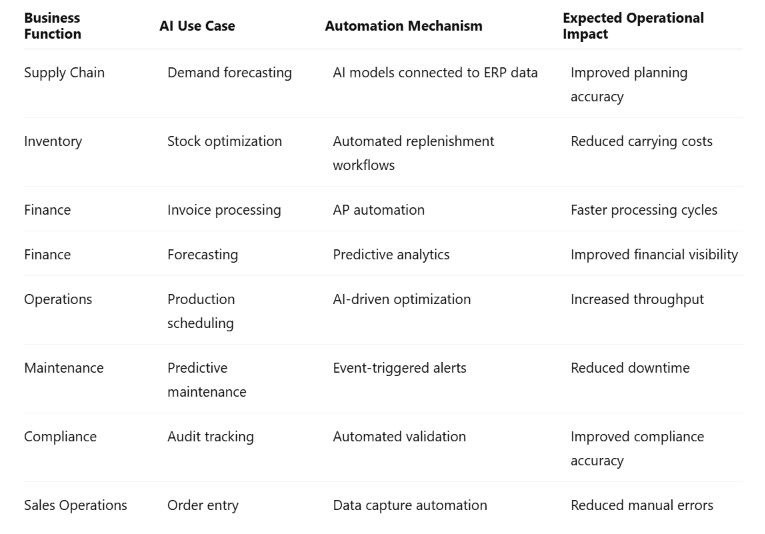
In supply chain operations, AI enables demand sensing that adjusts forecasts based on real-time signals. Procurement decisions become more responsive, and supplier performance can be evaluated continuously.
Inventory management benefits from predictive optimization. Stock levels can be aligned with actual demand patterns, reducing excess inventory while maintaining service levels.
In finance, automation and AI work together to accelerate processes and improve accuracy. Invoice handling, reconciliation, and forecasting become faster and more reliable.
Manufacturing operations gain visibility into production constraints. Scheduling can be adjusted dynamically, and resources can be allocated more efficiently.
Predictive maintenance allows organizations to anticipate equipment failures before they occur. Maintenance activities become planned rather than reactive, reducing downtime.
Compliance processes can also be embedded into workflows, ensuring that transactions and records align with regulatory and internal requirements without relying on manual verification.
Operational Use Case:
Operationalizing AI with Platforms Like Fluent:
The practical application of AI-Powered Automation for Epicor ERP depends on how workflows are executed across systems. This is where platforms such as Fluent become critical.
Fluent operates as a connective layer between systems and processes. It enables organizations to move from isolated tasks to coordinated workflows that span ERP, CRM, and operational tools.
Data synchronization is a foundational capability. Fluent ensures that information between Epicor and connected systems remains aligned, eliminating inconsistencies that typically arise in multi-system environments. This synchronization is not a one-time process. It is continuous, supporting real-time decision-making.
In financial operations, Fluent automates invoicing by extracting data from documents and inserting it directly into ERP workflows. This reduces manual intervention while improving accuracy and processing speed.
Order entry and data entry processes can be handled similarly. Inputs from different sources are captured, validated, and routed into Epicor without requiring repetitive user actions. This significantly reduces friction in daily operations.
Operational workflows such as packing slip generation and time entry can also be automated. These are typically high-frequency tasks that benefit from consistency and speed. Automating them reduces administrative overhead and allows teams to focus on higher-value activities.
Fluent also introduces event-driven communication. Messages to customers or suppliers can be triggered automatically based on ERP events, ensuring timely, consistent communication without additional effort.
A critical component is the use of AI agents within Fluent. These agents analyze data across systems and generate insights that can directly trigger workflows. This closes the gap between analysis and execution, enabling a more responsive operational environment.
When these capabilities are combined, the result is not just automation of individual tasks. It is the orchestration of end-to-end processes that operate with minimal manual intervention.
Implementation Considerations
Implementing AI-powered automation requires alignment across data, systems, and people.
Data quality is a prerequisite. Inconsistent or incomplete data reduces the effectiveness of both AI models and automation workflows. Establishing governance and maintaining structured data is essential.
Integration must be approached deliberately. Systems need to communicate reliably, and data synchronization must be designed to support real-time operations rather than periodic updates.
Change management plays a significant role. Automation alters how work is performed. Teams must understand how processes evolve and how their roles adapt within a more automated environment.
Governance ensures that automation remains controlled and auditable. As workflows become more autonomous, organizations must maintain visibility into how decisions are made and executed.
Common Challenges and Misconceptions
A common misconception is that AI can replace all operational decision-making. In reality, AI enhances decisions but operates within defined parameters.
Data fragmentation is another challenge. When systems are not connected, automation cannot function effectively. Integration is not optional. It is foundational.
There is also a tendency to automate without redesigning processes. Automation amplifies existing workflows. If those workflows are inefficient, the result is limited improvement.
Adoption barriers often stem from uncertainty. Teams need clarity on how automation supports their work rather than replaces it. Without this understanding, resistance can slow progress.
Practical Guidance for Implementation:
Organizations should approach AI-Powered Automation for Epicor ERP in a structured and pragmatic way:
- Start with processes that are repetitive and measurable. Invoice handling, order entry, and data synchronization are strong initial candidates because improvements are visible and quantifiable.
- Implement incrementally. Pilot initiatives allow organizations to validate assumptions and refine workflows before expanding automation across the enterprise.
- Prioritize connectivity. Ensuring that systems are integrated and data flows seamlessly is more important than introducing complex AI models early.
- Focus on execution. AI insights only create value when they trigger actions. Connecting analytics to workflows should be a primary objective.
- Maintain oversight. Automation should be monitored continuously to ensure accuracy, compliance, and alignment with business objectives.
Future Outlook: AI Agents and Agentic ERP
ERP systems are moving toward environments where workflows are increasingly autonomous.
AI agents for Epicor Kinetic will continuously monitor operational data, identify deviations, and initiate corrective actions. These agents will operate within defined boundaries but with increasing independence.
AI agentic platforms for Epicor Kinetic will further integrate decision-making and execution. Instead of responding to individual events, systems will manage entire processes based on desired outcomes.
ERP environments will become more data-driven, combining internal and external data to support real-time optimization across functions.
The progression is clear. ERP systems are evolving from systems that record activity to systems that actively shape it.
AI-Powered Automation for Epicor ERP is a key component of this transformation. It enables organizations to move beyond efficiency gains toward a model in which operations are continuously optimized through connected data, intelligent analysis, and coordinated execution.
Frequently Asked Questions
Fluent integrates with Epicor ERP through secure APIs, middleware, and event-driven architecture to enable real-time data exchange and workflow orchestration. It connects ERP modules with external systems such as CRM platforms, messaging tools, and analytics engines, ensuring seamless interoperability. This integration allows Fluent to trigger automated actions based on ERP events (e.g., order creation, invoice receipt), synchronize data across systems, and eliminate redundancies. The result is a unified digital ecosystem where information flows continuously and processes are executed without manual handoffs.
The return on investment (ROI) from AI automation in ERP systems is driven by both cost savings and performance improvements. Organizations typically experience reduced labor costs due to automation of manual tasks, faster processing cycles, and fewer errors requiring correction. Additionally, improved data accuracy and real-time insights lead to better decision-making, increased productivity, and enhanced customer satisfaction. Over time, these gains compound, allowing businesses to scale efficiently while maintaining operational control and competitiveness.
AI enhances ERP efficiency by automating repetitive tasks, accelerating data processing, and enabling real-time decision support. Unlike traditional automation, AI can interpret unstructured data (such as PDFs or emails), identify patterns, and make context-aware decisions. This reduces bottlenecks caused by manual input and approval delays. Additionally, AI-driven workflows can operate continuously, ensuring faster turnaround times and improved process consistency. Over time, the system becomes more accurate and efficient as it learns from historical data and user behavior.
Yes, Fluent enables fully automated, bidirectional data synchronization between Epicor ERP and CRM systems such as SugarCRM. This ensures that customer, order, financial, and operational data remain consistent and up to date across platforms. By eliminating manual data transfers and reconciliation efforts, businesses gain a single source of truth, improving collaboration between sales, finance, and operations teams. Real-time synchronization also enhances forecasting accuracy, customer service responsiveness, and overall business alignment.
Fluent delivers measurable operational and strategic benefits by embedding AI into ERP workflows. These include significant reductions in manual data entry, improved data accuracy, faster transaction processing, and enhanced visibility through real-time analytics. It also strengthens system integration by synchronizing data across ERP and CRM platforms. From a business perspective, this leads to lower operational costs, improved compliance, better customer responsiveness, and increased scalability. Organizations can handle higher transaction volumes without proportional increases in headcount.
AI-powered automation in Epicor ERP refers to the application of artificial intelligence technologies—such as machine learning, intelligent document processing, and rule-based agents—to execute and optimize core business processes without manual intervention. Instead of relying on static workflows, AI-driven systems like Fluent continuously learn from data patterns, enabling dynamic decision-making, automated data entry, anomaly detection, and predictive insights. This transforms Epicor ERP from a transactional system into an intelligent operational platform that proactively improves efficiency, accuracy, and responsiveness across departments.
A wide range of ERP processes can be automated using AI, particularly those that are repetitive, data-intensive, or time-sensitive. These include invoice processing (accounts payable/receivable), order management, inventory updates, demand forecasting, reporting, and customer or supplier communications. Fluent extends automation across functional areas such as finance, supply chain, and customer engagement by enabling intelligent workflows that adapt to business rules and real-time data. This reduces cycle times, minimizes human error, and frees up teams to focus on higher-value strategic activities.
Fluent enhances ERP analytics by deploying AI agents that continuously monitor, process, and analyze data across the system. Instead of relying on static reports, users gain access to dynamic, real-time insights that reflect current operational conditions. Fluent can automatically generate dashboards, identify trends, and trigger alerts when anomalies or opportunities are detected. This empowers decision-makers with timely, actionable intelligence, enabling proactive management rather than reactive reporting.
Fluent is particularly well-suited for manufacturing organizations leveraging Epicor Kinetic, as it aligns with the platform’s focus on real-time data and operational efficiency. Manufacturers can use Fluent to automate production scheduling updates, inventory synchronization, supplier communications, and shop floor data collection. Additionally, AI-driven analytics provide insights into production performance, downtime, and demand trends. This enables manufacturers to optimize throughput, reduce waste, and respond quickly to changing market conditions.
AI-driven invoice automation uses intelligent document processing to extract key data points—such as vendor details, invoice numbers, line items, and totals, from PDFs or electronic invoices. Machine learning models validate this data against ERP records, flag discrepancies, and automatically post entries into the system. Fluent enhances this process by incorporating workflow automation for approvals and exception handling. This dramatically reduces processing time, minimizes human error, and accelerates financial operations such as accounts payable and receivable.


