
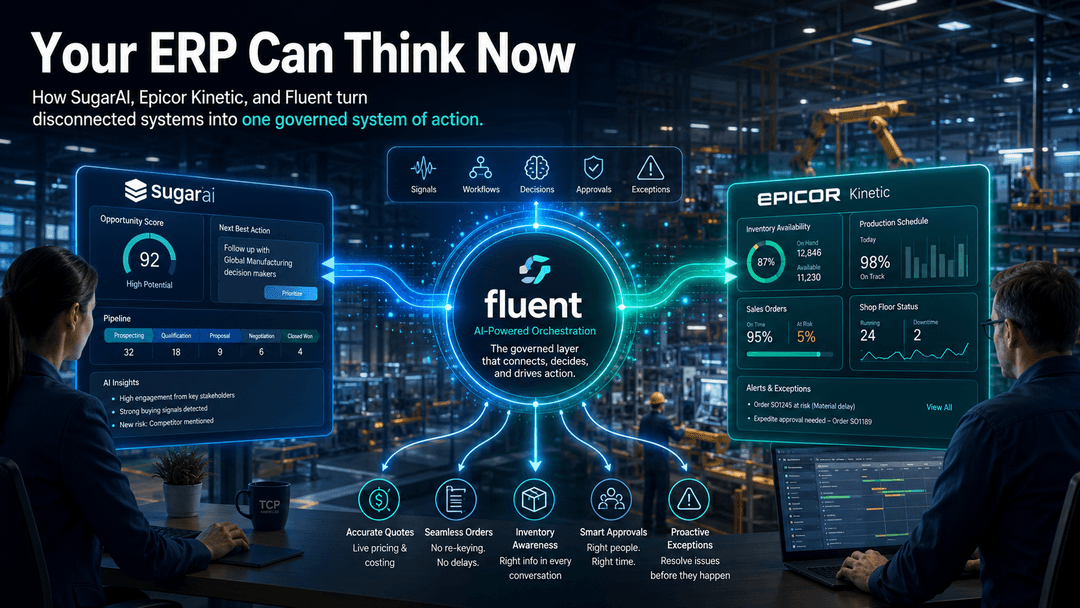
Tu ERP puede pensar ahora.
Cómo SugarAI, Epicor Kinetic y Fluent convierten sistemas desconectados en un sistema de acción gobernado.

Christian Wettre
EVP, GM North America
Tu equipo de ventas cierra un trato. Alguien vuelve a ingresar el pedido en Epicor. Los precios se basan en los datos de la semana pasada. El equipo de operaciones se entera dos días después. No falló nada, pero tampoco se movió rápido.
Este es el costo real de los sistemas desconectados. No hay una falla catastrófica única, sino un drenaje constante de tiempo, precisión y rapidez competitiva en cada cotización, pedido y traspaso.
El cambio que está sucediendo ahora mismo en la manufactura no se trata solo de añadir IA a tu CRM o a tu ERP. Se trata de hacer que esos sistemas actúen juntos: mostrar las señales correctas, activar los flujos de trabajo adecuados y hacer avanzar el trabajo sin reingreso manual ni coordinación por canales paralelos.
La promesa central de esta guía: Aprenderás cómo SugarAI, Epicor Kinetic y Fluent funcionan como un único sistema supervisado de acción, y cómo construir esa arquitectura sin sobreingenierizar la implantación.
Qué cubre esta guía:
- Qué significa realmente un sistema de acción tanto en el piso de fábrica como en la organización de ventas
- Por qué SugarAI y Epicor Kinetic están más potentes conectados que por separado
- Cómo Fluent gobierna la capa de orquestación entre CRM y ERP
- Una secuencia de configuración práctica y los casos de uso que valen la pena automatizar primero
- Qué puede salir mal y cómo evitarlo
Qué significa realmente un sistema de acción en la fabricación
La mayoría de los fabricantes ya tienen un sistema de registro. Epicor captura la transacción. SugarAI registra la oportunidad. Pero registrar lo ocurrido no es lo mismo que hacer algo al respecto.
Un sistema de acción es software que no solo almacena o muestra datos: recomienda, dirige o activa los siguientes pasos basados en condiciones reales del negocio. No hay que esperar un informe. No hay escalamiento manual de una excepción. El sistema lee la señal y mueve el trabajo.
Definición: Un sistema de acción conecta los datos operativos con la ejecución del flujo de trabajo. Cuando cambian las condiciones: se cierra un trato, baja el inventario, un pedido está en riesgo, el sistema responde sin requerir que un humano lo notice primero.
En Epicor Insights 2026, este concepto fue enmarcado como ERP cognitivo: la evolución del ERP desde un simple registrador pasivo a un participante activo en las operaciones. Epicor describió un ERP que puede priorizar órdenes expedites, reconciliar facturas de flete y reordenar el trabajo en planta basado en señales en vivo - no ejecuciones por lotes de fin de día.
En la práctica, el valor se muestra a través de los flujos de trabajo que los fabricantes ya ejecutan cada día:
- Precios y cotización: Los costos en tiempo real del ERP alimentan los flujos de cotización impulsados por CRM, eliminando precios desactualizados
- Entrada de pedidos: Datos validados que se trasladan directamente al ERP sin volver a ingresarlos
- Conocimiento de inventario: Contexto de stock y cumplimiento que se muestra en las conversaciones de ventas
- Enrutamiento de aprobaciones: Las excepciones se escalan automáticamente en función del tamaño del trato, margen o nivel de cliente
- Manejo de excepciones: Pedidos retrasados, cuentas en riesgo y demoras en el cumplimiento señaladas antes de convertirse en problemas
La supervisión humana sigue siendo esencial. Los agentes de IA en la fabricación no están sustituyendo el juicio operativo, sino eliminando la fricción de coordinación que lo ralentiza.
Por qué SugarAI y Epicor Kinetic son más fuertes juntos
SugarAI está diseñado para inteligencia de ventas. Muestra las cuentas con mayor potencial, señala señales de alerta temprana en tu pipeline y dice a los representantes exactamente qué hacer a continuación. Nucleus Research nombró a SugarAI como Líder en la Matriz de Valor de Tecnología de Automatización de Fuerza de Ventas 2025, con el analista Cameron Marsh señalando específicamente su fortaleza para "manufactura, distribución y venta al por mayor, donde los acuerdos complejos, con múltiples interesados y ciclos largos son comunes".
Pero la inteligencia de ventas sin contexto operativo sigue siendo conjetura. Si SugarAI no sabe que la pieza que un representante acaba de cotizar está en pedido atrasado, o que los últimos tres pedidos del cliente se enviaron con retraso, la orientación de la próxima mejor acción es incompleta. Esa es la brecha que llena Epicor Kinetic.
Epicor Kinetic es la fuente de verdad operativa. El historial de pedidos, la disponibilidad de artículos, los niveles de precios, las programaciones de producción y los datos financieros permanecen en Kinetic. Nada evita ERP como el registro autorizado. Cuando esos datos fluyen hacia la capa de CRM, las conversaciones de ventas son más precisas y la ejecución más rápida.
[SANITY_BLOCK:eyJf...]
La brecha en esa última fila es intencional. Ningún sistema fue diseñado para gobernar los traspasos entre ellos. Eso es exactamente lo que la capa de integración debe resolver - y por qué la pregunta de arquitectura importa más que la selección de software para la mayoría de los fabricantes ya usando ambas plataformas.
Para una mirada más profunda a cómo SugarAI encaja en la complejidad de ventas de fabricación, el perfil de capacidades va mucho más allá de la gestión de pipeline CRM estándar.
La Arquitectura: SugarAI + Kinetic + Fluent
Una vez que aceptas que ni SugarAI ni Epicor Kinetic gobiernan los traspasos entre ellos, la pregunta de arquitectura se vuelve clara: necesitas una capa de orquestación. Ahí es donde entra Fluent.
Fluent es la plataforma de automatización de flujos de trabajo impulsada por IA de TCP, creada específicamente para entornos de Epicor y SugarAI. No reemplaza a ninguno de los sistemas. Los conecta, gestionando mapeos de campos, enrutamiento de aprobaciones, manejo de excepciones y la sincronización de la automatización para que el trabajo se mueva entre CRM y ERP sin intervención manual ni código personalizado frágil.
Cómo trabajan juntos las tres capas
Piénsalo como tres roles distintos en un solo modelo operativo:
- SugarAI maneja la inteligencia orientada al vendedor. Los representantes ven puntuaciones de oportunidades, señales de riesgo, preparación para reuniones y orientación de la próxima mejor acción, todo presentado desde CRM y enriquecido con el contexto de ERP que llega desde Kinetic.
- Epicor Kinetic sigue siendo el sistema operativo y transaccional de verdad. Precios, inventario, estado de pedidos, programaciones de producción y datos financieros permanecen en Kinetic. Nada evita ERP como el registro autorizado.
- Fluent gobierna la orquestación. Gestiona qué datos se mueven entre los sistemas, cuándo se requieren aprobaciones, cómo se enrutan las excepciones y qué flujos de trabajo se ejecutan automáticamente frente a aquellos que requieren confirmación humana.
Por qué la capa de integración debe estar preparada para el futuro
La versión 2026.1 de Epicor se movió por completo a una arquitectura basada en navegador: el cliente inteligente desapareció. El desarrollo local (en las instalaciones) termina después de 2028.1. Eso significa que cualquier integración construida sobre ganchos heredados del lado del cliente o acoplamiento SQL rígido ya tiene fecha de caducidad.
Una arquitectura preparada para el futuro asume la UX del navegador como la única interfaz, utiliza conectividad basada en API para flexibilidad y está consciente de la nube para no luchar contra la dirección del producto de Epicor a medida que avanzan las migraciones. Fluent está diseñado alrededor de este modelo, por lo que evita los patrones de integración frágiles que generan deuda de soporte con el tiempo.
El resultado práctico: Los representantes trabajan en SugarAI. Los equipos de operaciones trabajan en Epicor. Fluent mueve los datos, enruta las aprobaciones y activa los flujos de trabajo entre ellos. Sin re-ingresos. Sin retrasos. Sin hilos de correo electrónico colaterales para llenar los vacíos.
Cómo configurar la integración CRM-ERP de Epicor Kinetic sin sobreingenierías
El error más común que cometen los fabricantes con la integración CRM-ERP es intentar conectar todo de una vez. El resultado es un proyecto desbordante que toma meses, crea cadenas de dependencia que nadie comprende completamente y, eventualmente, se derrumba por su propio peso.
Un enfoque mejor: comenzar de forma estrecha, demostrar valor rápidamente y luego expandirse.
La secuencia de configuración que funciona
Paso 1: Elige un flujo de trabajo en el que la fricción de la transferencia sea medible. De cotización a pedido y la entrada de pedidos son los puntos de partida correctos. La fricción es visible: entrada duplicada, demora en aprobaciones, precios desactualizados, y la mejora es fácil de medir. No comiences con un flujo de trabajo que requiera resolver gobernanza de datos y arquitectura de integración al mismo tiempo.
Paso 2: Define la propiedad de los datos antes de comenzar la automatización. Decide qué sistema posee cada tipo de dato antes de escribir una única regla de flujo de trabajo. Maestro de clientes, números de parte, niveles de precios, niveles de inventario: cada uno necesita una fuente única de verdad declarada. La propiedad ambigua es la causa raíz de la mayoría de fallos de integración, no la tecnología.
Paso 3: Construye flujos de trabajo supervisados primero. Cada paso automatizado necesita una ruta de aprobación, un rastro de auditoría, una ruta de excepciones y un propietario asignado. La orientación de IBM sobre implementaciones de agentes de IA es clara: los despliegues empresariales confiables requieren restricciones prácticas y un alcance cuidadoso, no autonomía total desde el inicio.
Paso 4: Confirma que tu entorno está preparado para navegador y para API. La versión 2026.1 de Epicor Kinetic es solo navegador. Si tu entorno aún depende de personalizaciones del cliente inteligente o integraciones heredadas basadas en BAQ, evalúalas antes de agregar conectividad CRM. El diseño API-first de Fluent funciona con la arquitectura a la que se dirige Epicor, no en su contra.
Paso 5: Asigna la propiedad del soporte antes del go-live. ¿Quién posee la integración cuando algo falla? Define si el soporte recae en TI, en el socio de implementación, o en una capa de servicios gestionados, y documentarlo antes de activar.
Conclusión clave: Un despliegue por etapas con una clara propiedad de los datos y flujos de trabajo supervisados superará a un proyecto de integración integral cada vez. La rapidez proviene de la disciplina del alcance.
Para los fabricantes que evalúan automatización de flujos de IA en ERP, los principios de secuenciación se aplican tanto si empiezas desde cero como si optimizas una integración existente.
Los primeros casos de uso de fabricación que vale la pena automatizar
La arquitectura solo es útil cuando se mapea a los flujos de trabajo que tus equipos realmente ejecutan. Aquí están los cuatro casos de uso que ofrecen el valor inicial más claro para los fabricantes que conectan SugarAI, Epicor Kinetic y Fluent.
Automatización de cotización a pedido
Los representantes de ventas acceden a BOMs en vivo, costos de materiales, tasas de mano de obra y disponibilidad de inventario directamente desde la interfaz de cotización en SugarAI. Fluent extrae esos datos de Epicor en tiempo real, por lo que la búsqueda de precios se detiene. Las cotizaciones salen más rápido, los márgenes quedan protegidos y los acuerdos aprobados se convierten en órdenes de venta sin reingreso manual. El patrón de automatización de entrada de pedido con IA se aplica aquí: los datos validados fluyen al ERP automáticamente, no a través de una cadena de copiar y pegar.
Aceleración de la entrada de pedidos
Fluent lee las órdenes de compra entrantes, las mapea a los campos de Epicor, las valida contra los precios actuales y la disponibilidad de piezas, y crea la orden de venta, señalando excepciones para revisión humana en lugar de permitir que datos incorrectos se propaguen a la producción. Este es uno de los puntos de partida con mayor ROI porque la fricción es fácil de cuantificar: tiempo por pedido, tasa de errores y volumen de retrabajo son todos medibles antes y después.
Visibilidad de riesgo de pipeline y cuentas
SugarAI marca cuentas donde los ingresos están en riesgo: tratos estancados, seguimientos perdidos, disminución de la frecuencia de pedidos, y muestra esa inteligencia junto a los datos de pedido y cumplimiento de Epicor. Los líderes de ventas y los equipos de operaciones ven la misma imagen. Ya no se descubre que un cliente está en riesgo después de que ya haya realizado su próximo pedido con un competidor.
Enrutamiento de traspasos entre funciones
Fluent enruta las próximas acciones entre ventas, servicio al cliente y operaciones basándose en la etapa del trato, el estado del pedido y los hitos de cumplimiento. Las aprobaciones van automáticamente a la persona adecuada. Las excepciones se escalan sin cadenas de correo. El flujo de trabajo no depende de que alguien recuerde reenviar un mensaje.
[SANITY_BLOCK:eyJf...]
Qué evaluar antes del despliegue
Antes de definir el alcance de un proyecto de integración, realiza una evaluación interna rápida. Las respuestas te dirán si estás listo para construir o si necesitas resolver algunos problemas fundamentales primero.
- ¿Dónde falla hoy la transición de cotización a pedido? Identifica el traspaso específico: entrada duplicada, demora en aprobaciones, precios desactualizados o visibilidad deficiente, que causa la mayor fricción.
- ¿Qué equipos son responsables de ventas, operaciones y decisiones de cumplimiento? Mapea dónde aún existe trabajo fuera de los canales formales: hilos de correo, hojas de cálculo, conversaciones informales que nunca quedan documentadas.
- ¿Tu entorno de Epicor está listo para navegador? Si aún usas un cliente inteligente o personalizaciones heredadas, esa es la primera cosa a abordar.
- ¿Tienes acceso API habilitado en Kinetic? El modelo de integración de Fluent depende de la conectividad API. Confírmalo antes de iniciar las conversaciones de arquitectura.
- ¿Quién posee la integración después de la implementación? La responsabilidad de soporte debe definirse antes del go-live, no después del primer incidente.
Esta evaluación es también el punto de partida para una conversación de evaluación de flujos de trabajo de fabricación: una que mapea tus puntos de fricción actuales a los flujos de trabajo que más valen la pena automatizar primero.
Comienza con un flujo de trabajo
Los fabricantes no necesitan autonomía total desde el primer día. Necesitan un único flujo de trabajo conectado que demuestre valor lo suficientemente rápido como para generar confianza interna para el siguiente.
El mejor punto de partida es la automatización supervisada de cotización a pedido o de entrada de pedidos, donde la fricción entre ventas y ERP es más fácil de medir y donde la mejora es inmediatamente visible para el equipo de ventas y operaciones.
Según la investigación de PwC de 2025, el 79% de los altos ejecutivos ha adoptado agentes de IA, y el 66% reporta valor de productividad medible. Los fabricantes que obtienen esos resultados no son los que intentaron los programas de transformación más grandes. Son quienes empezaron con un flujo de trabajo específico, lo gobernaron adecuadamente y se expandieron a partir de ahí.
SugarAI aporta la inteligencia. Epicor Kinetic mantiene la verdad operativa. Fluent los conecta y mantiene la ejecución gobernada. Ese es el sistema de acción, y empieza con un flujo de trabajo, no con una revisión completa de la plataforma.
¿Listo para mapear tu primer flujo de trabajo? Solicita una evaluación de flujos de trabajo de fabricación, e identificaremos dónde la automatización de cotización a pedido o entrada de pedidos entrega el valor más rápido y medible para tu equipo.
O si aún estás en la fase de evaluación, habla con TCP sobre la arquitectura de integración CRM-ERP y su implantación - trabajamos con fabricantes que utilizan Epicor Kinetic y SugarAI a diario.


